
If you have ever invested some of your time into learning about algorithms, forex trading, and high-frequency trading methods, you must have encountered the term “trading server” at least once. This might seem to be another buzzword coined by brokerages and developers for beginners. In reality, a trading server is one of the core elements of modern finance, and by gaining insight into how a trading server works, you will be able to make informed decisions regarding your own trading system.
What Is a Trading Server?
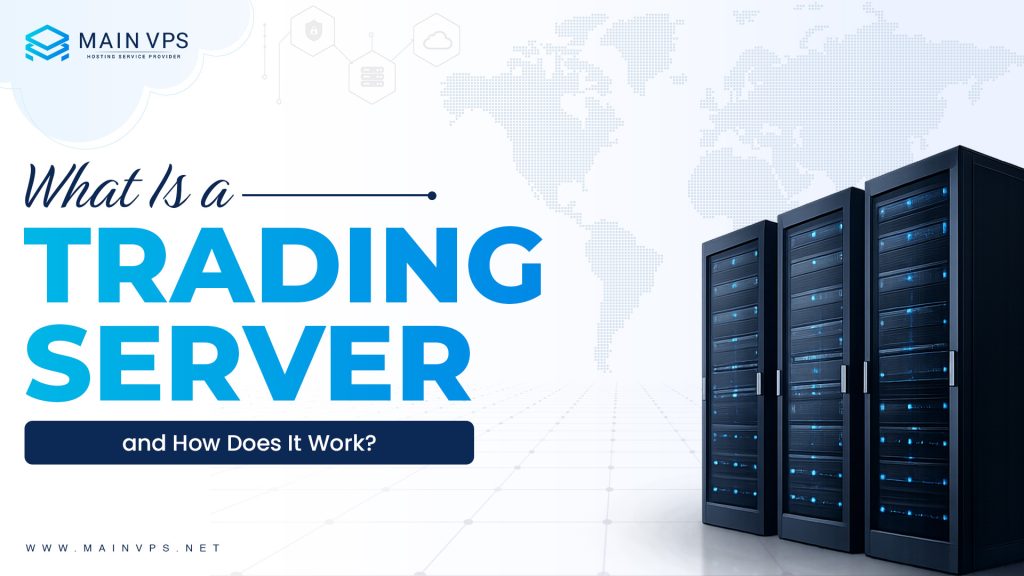
A trading server is a specialized computer system that carries out transactions with financial market orders. Unlike setups where all trading terminal functions run on your laptop or desktop, a trading server serves as the main link between the trader, the broker, and the exchange (or liquidity provider).
Let us try to imagine it in the following way: each time you send a buy/sell order from your MetaTrader 4, MetaTrader 5, or any other terminal, this order should not disappear into thin air but travel somewhere, find a counterparty, and get confirmed within a few milliseconds. And this machine becomes your trading server.
Trading servers are normally situated in data centers with high-speed internet access that are located as close as possible to stock exchanges or liquidity providers.
Why Do Trading Servers Exist?
Before dedicated forex vps hosting became standard, trades were processed manually or through slower, less reliable systems. As markets became more electronic and trading volumes exploded, the need for fast, stable, and secure infrastructure became critical. A few key reasons trading servers exist include:
- Speed and efficiency: Markets move fast, and even a delay of a few milliseconds can mean the difference between a profitable trade and a missed opportunity.
- Reliability: Trading servers are built to run 24/7 with minimal downtime, which is essential for markets like forex that operate around the clock.
- Order matching: Servers handle the complex job of matching buy and sell orders between multiple parties.
- Data processing: They process massive amounts of market data, price feeds, and trade confirmations continuously.
- Security: Financial data and transactions require strong protection against cyberattacks and unauthorized access.
How Does a Trading Server Work?
To understand how a trading server works, it helps to follow the journey of a single trade, from the moment you click “Buy” or “Sell” to the point when the order is executed and confirmed. Behind this simple action, several systems communicate within milliseconds to verify, route, execute, and record the trade.
1. Order Placement
Once you open a trading terminal and make an order, the request will be encoded into digital information and forwarded to the trading server from your computer or other devices.
Depending on your trading strategy, the order may be a market order, limit order, stop order, stop-loss, or take-profit order. In case you make a market order of EUR/USD, the order request will be transmitted to the trading system of the broker.
The speed and reliability of your connection between the trading terminal and the server might impact the time it takes to reach the broker. That is why traders who employ automated trading systems usually care about server locations and network latencies.
2. Order Processing
After receiving the order request, the forex VPS trading server processes it according to the broker’s rules and trading infrastructure. Before an order can be executed, the system may perform several checks automatically.
These checks can include:
- Available account balance
- Required margin
- Trading account status
- Order volume
- Instrument availability
- Trading restrictions
- Risk-management rules
- Validity of the requested order conditions
If the order meets the requirements, it can move to the next stage. If there is insufficient margin, an invalid order size, or another restriction, the request may be rejected.
This automated processing allows brokers to handle large numbers of orders without manually reviewing every individual transaction.
3. Order Routing
After the order goes through all the necessary checks, the forex trading server decides where it should be routed for execution. The routing procedure itself varies based on the way the broker conducts its business, trading infrastructure, and type of financial asset.
Depending on the configuration, an order can go to:
- A liquidity provider or financial institution
- Be matched internally with another client’s order
- An exchange or other execution venue
- An electronic liquidity network
This step is critical because brokers have different ways of executing orders. Traders need to know how their broker routes their orders instead of thinking that all orders follow the same route.
4. Execution
Once the order gets to the right place for its execution, it gets executed based on the current market conditions and the rules of that particular trading system.
The execution price in case of market orders might not coincide with the price that was seen at the moment the order was placed. The difference between the execution price and the price when placing an order is called slippage and may happen due to rapid price movement and changes in liquidity.
In cases of highly liquid and stable market conditions, order execution may go rather fast. In case of sudden changes in liquidity and during announcements of key economic information or sharp price movements, conditions for execution may change quickly.
In case of automated traders, fast and reliable communication becomes especially significant.
5. Confirmation and Data Update
Once the order is executed, the result is communicated back to the trading platform via the broker’s infrastructure. As a result, the trader receives essential information such as the execution price, order status, position size, and transaction info.
Also, the trading server and other backend services update the account information, which may include:
- Account balance
- Available margin
- Used margin
- Open positions
- Profit and loss
- Trade history
- Stop-loss and take-profit levels
This information allows the trader to monitor the current state of the account. The transaction is also recorded within the broker’s systems for reporting, account management, and applicable regulatory or compliance requirements.
6. Continuous Market Data Streaming
A trading server does not only process orders. It also continuously handles market data and communicates information to connected trading platforms.
This can include:
- Live bid and ask prices
- Price changes
- Charts and candles
- Trading volume information
- Market depth, where available
- Account and position updates
- Trading alerts and notifications
As market prices fluctuate, new information is sent to the trading platform. This is how a trader is able to watch a chart and observe prices changing continuously.
For automatic trading systems, continuous data flow is of special importance. The Expert Advisor (or the algorithm) analyzes data from the market and, depending on certain criteria, sends an order automatically.
Types of Trading Servers
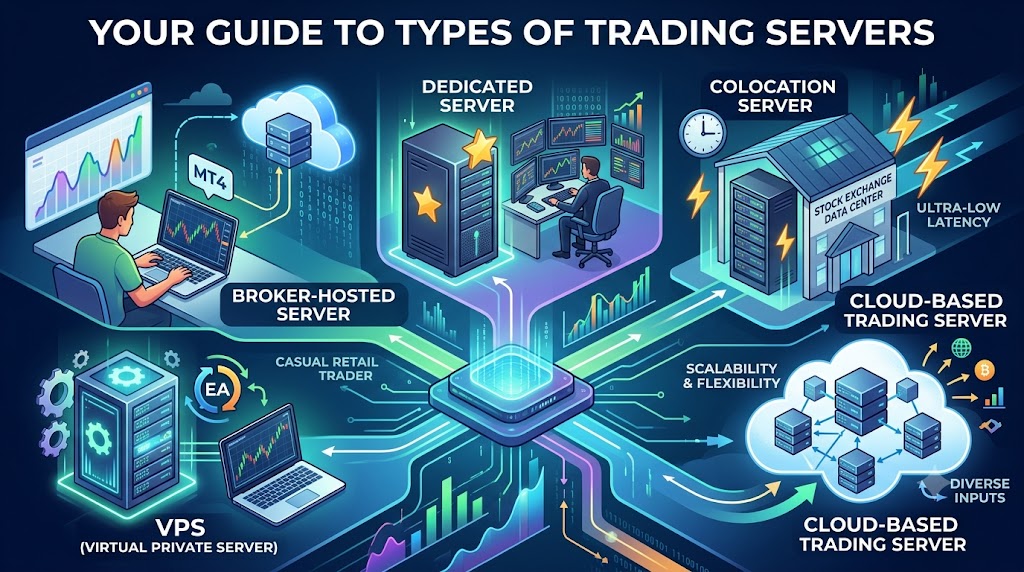
| Type of Trading Server | Description | Best Suited For |
| Broker-Hosted Server | A server managed and maintained by the broker, allowing traders to connect to their trading platform remotely. | Retail traders using platforms such as MT4 or MT5 |
| VPS (Virtual Private Server) | A virtual server that provides traders with a dedicated environment to run trading platforms, expert advisors, and automated strategies. | Automated trading, expert advisors, and algorithmic strategies |
| Dedicated Server | A physical server reserved for a single trader, company, or trading operation, providing greater control and resources. | Professional traders, high-frequency trading, and institutional firms |
| Colocation Server | A server located inside or close to an exchange or financial data center to reduce network distance and latency. | High-frequency trading and ultra-low-latency strategies |
| Cloud-Based Trading Server | A trading environment running on cloud infrastructure, providing flexible resources that can be adjusted according to requirements. | Traders who need scalability, flexibility, and remote access |
Key Components of a Trading Server
A trading server isn’t just a single piece of hardware; it is a combination of hardware, software, networking, databases, and security systems working together. Each component has a specific role in keeping trading platforms connected, processing orders, managing account information, and maintaining reliable operations.
1. The Hardware That Powers Trading Operations
The hardware setup serves as a platform that is able to provide computing resources for trading apps and the processing of huge volumes of information. The hardware usually consists of powerful processors, enough RAM, fast SSD or NVMe disks, etc.
The volume of needed hardware will depend on how many trading accounts, trading platforms, automated trading systems, and market data processors work in parallel. Hardware stability is important to eliminate performance problems of working multiple applications at once.
2. A Stable Network Keeps Data Moving
A stable and fast internet connection is needed since forex trading servers have ongoing interaction with the trading platform, brokers, liquidity providers, etc. Professional data centers could implement several connections, multiple carriers, and alternative routes in order to lessen the effect of network outages. The location of the server may affect latency, especially if it interacts with the broker or execution venue.
3. Software Controls the Trading Environment
Management of most of the processes that are essential for a trading platform is handled by the software layer. Depending on the configuration, it may consist of MetaTrader Server, cTrader Server, or a specially designed trading/matching engine.
This software is capable of handling such tasks as order management, account management, market data management, execution workflow, and inter-component communication. In essence, it defines the processes for trading infrastructure.
4. Managing Risk Before Orders Are Executed
Risk management systems track transactions and implement certain rules set up for accounts and brokers. They can verify margin, positions, leverage, exposure, and other parameters of the trading process.
Such risk management systems can activate certain measures if risk criteria are met in specific accounts, for example, margin call and stop-out criteria. In addition, broker systems can utilize risk management software to detect any abnormal behavior.
5. Where Trading Data Is Stored
Trading servers rely on databases for the storage and retrieval of a vast amount of information, such as historical prices, completed transactions, open orders, balances, transactional history, and much more.
Good databases make sure that trading software and broker software can access this information faster, as well as facilitate reporting, account management, and other processes.
6. Security Keeps the Trading Infrastructure Protected
Security plays an important role in any trading infrastructure since trading infrastructure deals with financial and account information.
The trading servers may employ various security mechanisms like encryption, firewalls, secure authentication, access control, and monitoring. The updating of software plays an important role in ensuring that security vulnerabilities are minimized.
Why Latency Matters So Much
Latency refers to the period required for transmission of information from one end to another, and it is one of the most important reasons for traders to think about trading servers. Latency is not an issue in the case of slower investments, where there is no problem even with a lag of one or two seconds. However, in fast-paced investing where scalping and other similar forms of trading take place, latency becomes crucial.
This is because most traders prefer to invest using a virtual private server that is closer to the broker’s server, compared to a local computer. It decreases the lag and increases the efficiency of trading by minimizing latency and avoiding slippage.
For context, here’s a simple breakdown of how location affects latency:
| Setup | Typical Latency | Impact on Trading |
| Home computer, standard internet | 100–300 ms | Noticeable delays, higher slippage risk |
| VPS in a different region than the broker | 30–100 ms | Improved speed, still some delay |
| VPS in the same data center as the broker | 1–10 ms | Minimal delay, ideal for fast strategies |
| Colocation server | Less than 1 ms | Near-instant execution, used by institutions |
As you can see, the closer your server is to your broker’s infrastructure, the faster your trades execute.
Trading Servers vs. Personal Computers
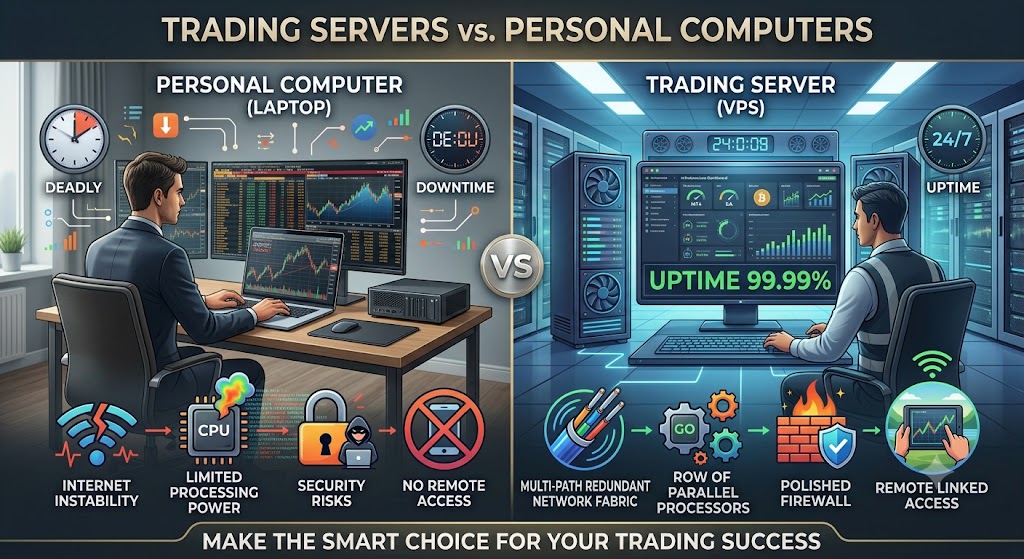
A common question beginners ask is, “Why can’t I just run my trading platform from my own laptop?” Technically, many retail traders can do exactly that. But there are meaningful downsides compared to using a dedicated trading server or VPS.
- Uptime: Your home computer might crash, lose power, or need updates. A trading server runs continuously without interruption.
- Internet stability: Home internet connections can be inconsistent. Trading servers use enterprise-grade, redundant connections.
- Processing power: Running multiple expert advisors or indicators can slow down a personal computer, especially during high market volatility.
- Security risks: Personal computers are more vulnerable to malware, which can be dangerous when sensitive financial data is involved.
- Remote access: A server allows you to monitor and control your trades from anywhere, even if your personal device is off.
For casual, low-frequency traders, a personal computer might be perfectly fine. But for anyone running automated strategies or trading frequently, a trading server setup often becomes essential.
Who Actually Uses Trading Servers?
Trading servers aren’t just for massive institutions; a wide range of market participants rely on them:
Retail Brokers: Every online broker offering forex, stocks, or crypto trading operates trading servers to manage client orders and data.
Algorithmic Traders: Traders running expert advisors, trading bots, or automated strategies often rent a VPS to keep their systems running 24/7.
Hedge Funds and Institutional Traders: Large firms often use colocation services to minimize latency and gain a competitive edge in fast markets.
Proprietary Trading Firms: These firms build custom trading infrastructure to support high-frequency strategies that require extremely fast execution.
Individual Day Traders: Even solo traders benefit from renting a VPS to ensure their trades execute reliably without depending on their home setup.
Common Challenges With Trading Servers
While trading servers offer major advantages, they aren’t without challenges. Some common issues include:
- Server downtime: Even reliable servers can occasionally experience outages, which can be costly during volatile market conditions.
- Cost: Dedicated servers, VPS hosting, and colocation services all come with ongoing fees.
- Technical knowledge required: Setting up and maintaining a server, especially for algorithmic trading, often requires some technical skill.
- Cybersecurity threats: As financial hubs, trading servers are frequent targets for hacking attempts, making strong security essential.
- Choosing the right provider: Not all VPS or hosting providers offer the same speed, reliability, or proximity to major brokers.
How to Choose the Right Trading Server Setup
If you’re considering using a trading server or VPS for your own trading, here are a few factors worth thinking about:
- Location: Choose a server location close to your broker’s data center to reduce latency.
- Uptime guarantee: Look for providers offering at least 99.9% uptime.
- Resource allocation: Make sure the server has enough CPU, RAM, and storage for your trading software.
- Customer support: Reliable, responsive support matters, especially during technical issues in live markets.
- Security features: Look for providers offering DDoS protection, encrypted connections, and regular backups.
- Cost vs. performance: Balance your budget with the level of performance your trading strategy actually requires.
Final Thoughts
It is unlikely that the typical investor would consider the trading server an essential element of their trade. Yet, it is exactly what drives each trade made on modern financial markets. Low-latency trading servers process hundreds of thousands of transactions per second and are responsible for making sure everything works day and night flawlessly.
Knowledge about how the trading servers operate can provide a trader with valuable information related to the speed and efficiency of the trading process in general, regardless of whether it is done through the standard software provided by a broker or via automated trading.
Frequently Asked Questions
1. What is a trading server?
A trading server is a dedicated remote server designed to operate different trading applications such as trading platforms, automated trading software, expert advisors, and other applications related to trading. The main goal of using the server is to keep these applications up and running and connected for a long period of time.
2. How does a trading server work?
It processes orders, checks accounts and risks, sends orders through the network of a broker, and returns results of order execution to a trading platform.
3. Why do traders use a trading server?
The main requirement for traders is the constant operation of their trading platform regardless of the personal computer and the Internet connection at home.
4. Is a trading server the same as a VPS?
Not necessarily. A trading VPS is a special type of virtual server that is often used for trading. Speaking about trading servers, we mean a VPS or any other server that can run trading applications.
5. Can I run MetaTrader on a trading server?
Yes. A suitable trading server can run platforms such as MetaTrader 4 and MetaTrader 5, provided the server meets the platform’s operating system and resource requirements.
6. Can a trading server run Expert Advisors 24/7?
Yes, a trading server allows running MetaTrader and Expert Advisors continuously, regardless of whether your PC is switched on.
7. Does a trading server reduce trading latency?
While the closeness of a trading server to a broker or trading system can contribute to lower latency, the latency might still be affected by a variety of other factors.
8. What resources are important for a trading server?
The resources needed for a trading server include a processor, RAM, SSD/NVMe, network, and the whole infrastructure of the server. The required resources depend on how many trading platforms, accounts, and automated trading systems will be used.
9. Is a trading server secure?
If properly configured, a trading server can implement various safety measures, including firewalls, encryption, access controls, monitoring, regular security software updates, and more. Moreover, you have to take care of your trading account credentials and trading server login details.
10. Does a trading server guarantee profitable trading?
No. A trading server ensures stable conditions for working with trading software but does not guarantee any profits from trading. Trading success depends on multiple aspects, including trading strategy, risk management, market situation, broker, and more.
Suggestions:
- https://mainvps.net/blog/lifetime-web-hosting-2026/
- https://mainvps.net/blog/windows-reseller-web-hosting/
- https://mainvps.net/blog/best-wordpress-hosting-providers/
- https://mainvps.net/blog/linux-vps-hosting-india/
- https://mainvps.net/blog/low-cost-windows-vps-hosting-in-india/
- https://mainvps.net/blog/cheap-dedicated-server-hosting-providers/
- https://mainvps.net/blog/windows-server-guide-dde-dns-tls-1-2-uptime/
- https://mainvps.net/blog/dedicated-server-hosting-netherlands/
- https://mainvps.net/blog/dedicated-server-low-price/
- https://mainvps.net/blog/vps-hosting-in-los-angeles-us/
- https://mainvps.net/blog/dedicated-server-in-nedzone-nl/
- https://mainvps.net/blog/buy-linux-vps-hosting/
- https://mainvps.net/blog/managed-windows-vps-hosting/
- https://mainvps.net/blog/what-is-wmi-provider-host-complete-guide/
- https://mainvps.net/blog/cloud-hosting-vs-vps-2026/
- https://mainvps.net/blog/vps-hosting-for-ecommerce-guide/
- https://mainvps.net/blog/vps-hosting-for-saas-applications/
- https://mainvps.net/blog/vps-reseller-hosting-in-netherlands/
- https://mainvps.net/blog/dedicated-server-hosting-in-us/
- https://mainvps.net/blog/linux-reseller-hosting/
- https://mainvps.net/blog/dedicated-server-with-nvme-us/
- https://mainvps.net/blog/dedicated-server-with-root-access-us/
- https://mainvps.net/blog/dedicated-server-with-cpanel-us/
- https://mainvps.net/blog/litespeed-vps-hosting-in-netherlands/
- https://mainvps.net/blog/cheap-windows-vps-hosting/
- https://mainvps.net/blog/affordable-dedicated-server-netherlands/
- https://mainvps.net/blog/us-windows-vps-hosting/
- https://mainvps.net/blog/dedicated-server-hosting-services-in-the-us/
- https://mainvps.net/blog/cloud-servers-for-small-business/
- https://mainvps.net/blog/low-cost-dedicated-server-usa/