
What is a Hard Disk Drive (HDD)
A hard disk drive is a kind of data storage device utilized in a computer and a laptop to store all your data inside it. This drive utilizes magnetic storage to store and retrieve the digital data utilized by the computer. A person sitting with a computer system can access any desirable data with the availability of a hard disk drive. These storages are non-volatile storage; this signifies that data is still present when the power is turned off. Every company has commenced utilizing HDDs for their purpose, and each employee has their data stored in an HDD.
What is a Hard Disk Drive (HDD)
A hard disk drive is a kind of data storage device utilised in a computer and a laptop to store all your data inside it. This drive utilises magnetic storage to store and retrieve the digital data utilised by the computer. A person sitting with a computer system can access any desirable data with the availability of a hard disk drive. These storages are non-volatile storage; this signifies that data is still present when the power is turned off. Every company has commenced.
What is a Solid-State Drive (SSD)
As the designation verbalizes that data is stored in a solid-state. It is additionally known as a solid-state device or solid-state disk. The data inside an SSD are stored in semiconductor cells and retrieved as digital information utilizing electronic circuits. There is no utilization of mechanical components with an SSD. It has sundry types of form factors, sizes, and storage variants of computer systems.
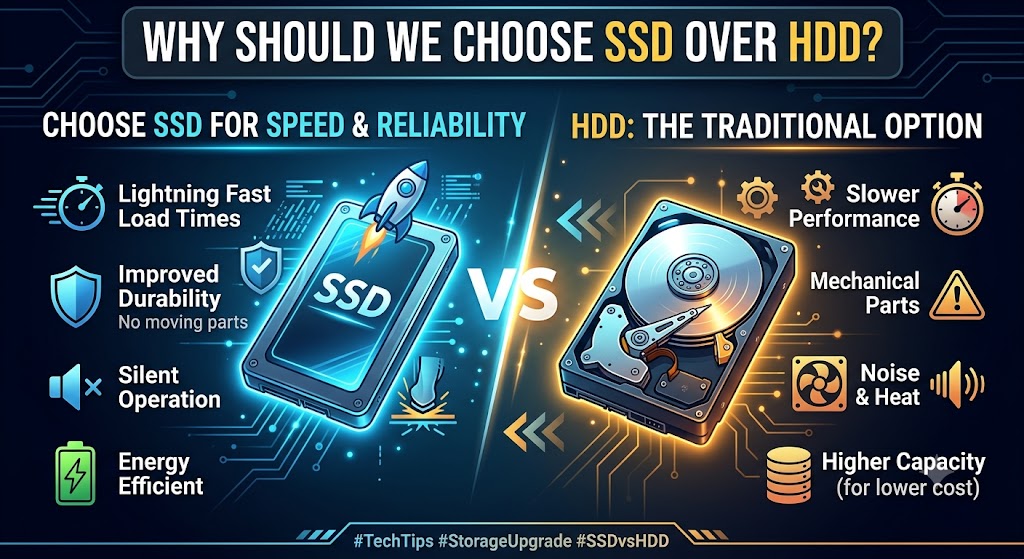
So, MainVPS will reveal the reason why we should choose SSD over HDD and how this will help store your website data or cloud data on servers.
1. Access Time
A traditional HDD typically takes around 10 milliseconds to access randomly located data, while an SSD can perform the same operation in less than 1 millisecond. This difference helps SSD-powered systems load applications faster, access files more quickly, and deliver better overall performance. Actual speeds depend on the drive type and workload.
2. Amounts
The price of an HDD is quite frugal compared to an SSD. This signifies that the prices of SSDs are higher, and a computer with an SSD can additionally have more HDDs for storage.
3. Dependability
The HDD has its moving part, making HDDs more vulnerable to physical shocks due to moving parts. The SSD does not have moving parts. SSDs use flash memory for storage and provide better performance and dependability compared to HDDs.
4. Magnitude
Multiple internal HDDs can be installed, depending on the available drive bays, ports, and space. These HDDs are quantified in terabytes that are available at an efficient rate. SSDs can additionally be quantified in terabytes, but most people can’t afford it due to the price, as it is beyond the range of mundane people.
5. Energy and Power
SSDs generally consume less power than HDDs, making them a power-efficient storage option for laptops and servers. HDDs use spinning magnetic platters and moving read/write heads, which require additional power to operate. However, actual power consumption depends on the drive model and workload.
6. Sound
HDDs engender a sizzling sound because of components such as spinning the platters and moving the read/write heads. So sometimes it engenders the loudest voice on your computer, and in SSD, no moving components are running in the SSD for web hosting, so it does not engender any noise.
7. Dimension
Virtually all HDDs are in 3.5 and 2.5 sizes for desktops and laptops. SSDs are available in various form factors, including 2.5-inch drives and M.2 modules, for desktops, laptops, and servers.
8. Heat
When the moving part commences running in an HDD, it generates heat that can gradually damage electronic components over time. If we compare it with an SSD, it does not have any moving components, due to which it generates less heat, which will help increase lifespan and reliability.
For website hosting and cloud environments, large amounts of data are stored on servers. Both HDDs and SSDs can store website files, databases, applications, and other server data. However, SSDs generally provide faster data access and better performance, while HDDs offer a cost-effective solution for storing large amounts of data. MainVPS helps you understand the key differences between SSD and HDD storage so you can choose the right solution for your needs.
SSD vs. HDD: Which One is Better for Hosting?
When it comes to web hosting and server environments, SSDs are considered the superior choice. Websites today require fast loading speeds, quick database access, and reliable performance to provide a seamless user experience. SSD storage helps achieve these goals by offering significantly faster read and write speeds than traditional HDDs.
For websites that receive high traffic, SSD-powered servers can process requests more efficiently, reducing loading times and improving overall website performance. This is particularly important for e-commerce stores, business websites, and applications where speed directly impacts user satisfaction and conversions.
Why Is SSD Better Than HDD for Modern Servers?
SSD storage is generally better than HDD storage for modern servers because it provides faster data access, lower latency, and more efficient handling of random read and write operations. These advantages can improve website responsiveness, database performance, and application loading times.
For example, an eCommerce website may need to retrieve product information, customer records, and inventory data from a database. SSD storage can reduce storage-related delays during these operations, helping the server respond more quickly.
SSD-based servers are particularly useful for:
Web hosting: Faster access to website files and databases.
VPS hosting: Responsive virtual servers for websites and applications.
Database hosting: Efficient handling of frequent data requests.
Cloud applications: Faster access to application files and stored data.
Business websites: Improved responsiveness for dynamic pages and online services.
However, storage is only one factor affecting server performance. CPU resources, RAM, network latency, caching, and application optimization also influence website speed.
For businesses choosing a hosting solution, SSD storage is a strong option when performance and responsiveness are priorities.
SSD vs HDD Comparison and Benefits
When comparing SSD vs HDD, the main differences are speed, storage technology, durability, power consumption, and cost. A Solid-State Drive (SSD) uses flash memory to store data electronically, while a Hard Disk Drive (HDD) uses rotating magnetic platters and mechanical read/write heads. SSDs are generally better for performance-focused tasks, whereas HDDs are a cost-effective option for storing large amounts of data.
SSD vs HDD Comparison Table
| Feature | SSD (Solid-State Drive) | HDD (Hard Disk Drive) |
|---|---|---|
| Speed | Faster data access and lower latency | Generally slower data access |
| Technology | Flash memory | Magnetic storage |
| Durability | Better resistance to physical shock | More vulnerable to physical shock |
| Power consumption | Generally lower | Generally higher |
| Noise | Silent operation | May produce mechanical noise |
| Cost | Higher cost per GB | Lower cost per GB |
| Best use | Web hosting, VPS, applications, and operating systems | Backups, archives, and large data collections |
Advantages of SSD Hosting for Websites
Faster Website Loading Speed
SSD storage can access data much faster than HDD vs SSD performance storage, helping websites load pages quickly. Faster websites improve user experience and can positively impact search engine rankings.
Better Server Performance
Web servers often handle multiple requests simultaneously. SSDs can process these requests more efficiently, resulting in smoother server performance and faster application response times.
Improved Reliability
SSDs have no moving parts, reducing the risk of mechanical failure. However, both SSDs and HDDs can experience hardware failures, and reliability depends on the drive quality and workload.
Lower Downtime Risks
SSDs are designed to operate efficiently under heavy workloads. Their reliability helps reduce the chances of hardware-related downtime, ensuring websites remain accessible to visitors.
Enhanced Database Performance
Many websites rely heavily on databases to store and retrieve information. SSD storage significantly improves database query performance, making websites faster and more responsive.
Why MainVPS Uses SSD Storage
At MainVPS, we understand the importance of speed, reliability, and performance for modern websites. That is why our hosting solutions utilize high-performance SSD storage to deliver faster loading times, improved uptime, and enhanced user experiences. Whether you are running a personal blog, business website, eCommerce store, or enterprise application, SSD-powered hosting can provide the performance needed to support your online growth.
Conclusion
Both HDDs and SSDs have their advantages, but SSDs clearly outperform HDDs in terms of speed, reliability, power efficiency, and overall performance. While HDDs remain a cost-effective option for large-scale storage, SSDs are the preferred choice for web hosting, cloud environments, and modern applications.
If your goal is to achieve faster website performance, better reliability, and improved user experience, SSD hosting is the ideal solution. Choosing SSD-powered hosting can help your website stay competitive and deliver the performance that today’s users expect.
FAQs
1. What is the main difference between SSD and HDD?
The primary difference is that SSDs use flash memory to store data, while HDDs use spinning magnetic disks. SSDs are faster, more reliable, and consume less power than HDDs.
2. Why is SSD better for web hosting?
SSD hosting provides faster data access, quicker website loading speeds, improved server performance, and better reliability, making it ideal for websites and applications.
3. Is SSD more reliable than HDD?
Yes. Since SSDs have no moving parts, they are less prone to physical damage and mechanical failures, making them more reliable than traditional HDDs.
4. Does SSD improve website speed?
Yes. SSDs offer significantly faster read and write speeds, which help websites load pages faster, improve database performance, and enhance the overall user experience.
5. Should I choose SSD or HDD for my website?
For most websites, SSD is the recommended choice because it delivers better speed, performance, and reliability. HDD is generally suitable for low-cost storage and backup purposes where speed is not a priority.
Suggestions:
- https://mainvps.net/blog/linux-reseller-hosting/
- https://mainvps.net/blog/lifetime-web-hosting-2026/
- https://mainvps.net/blog/windows-reseller-web-hosting/
- https://mainvps.net/blog/best-wordpress-hosting-providers/
- https://mainvps.net/blog/linux-vps-hosting-india/
- https://mainvps.net/blog/low-cost-windows-vps-hosting-in-india/
- https://mainvps.net/blog/cheap-dedicated-server-hosting-providers/
- https://mainvps.net/blog/windows-server-guide-dde-dns-tls-1-2-uptime/
- https://mainvps.net/blog/dedicated-server-hosting-netherlands/
- https://mainvps.net/blog/dedicated-server-low-price/
- https://mainvps.net/blog/vps-hosting-in-los-angeles-us/
- https://mainvps.net/blog/dedicated-server-in-nedzone-nl/
- https://mainvps.net/blog/buy-linux-vps-hosting/
- https://mainvps.net/blog/managed-windows-vps-hosting/
- https://mainvps.net/blog/what-is-wmi-provider-host-complete-guide/
- https://mainvps.net/blog/cloud-hosting-vs-vps-2026/
- https://mainvps.net/blog/vps-hosting-for-ecommerce-guide/
- https://mainvps.net/blog/vps-hosting-for-saas-applications/
- https://mainvps.net/blog/us-dedicated-server-provider/
- https://mainvps.net/blog/dedicated-server-with-cpanel-us/
- https://mainvps.net/blog/dedicated-server-with-root-access-us/
- https://mainvps.net/blog/dedicated-server-with-nvme-us/