


In this digital era, where speed is not a luxury but a necessity, a delay of a few milliseconds impacts user experience and search engine optimization. Users across the globe expect applications and websites to load in a split second. This is where latency becomes a concern, and VPS hosting is a crucial determinant in removing latency in international applications and websites.
This blog post is going to define latency, describe why it is important, and highlight how a VPS hosting environment eradicates it as opposed to a regular hosting solution.
Understanding Latency in Web Hosting
Latency is the lag, one might say, the delay, from a request made by a user to the response of the server. In other words, latency can be simply explained as the time it takes for data to move from a user’s device to a server and back.
Several factors determine latency:
- Physical distance between the user and the server
- Network routing and congestion
- The performance and availability of a server.
- Hosting architecture
Latency is more problematic for global sites and applications because users are accessing the service from different countries and continents.
Why High Latency Is a Serious Problem
High latency negatively affects almost every aspect of a digital product:
1. Poor User Experience
Slow-loading pages frustrate users. Studies show that users abandon websites that take more than a few seconds to load.
2. Lower Conversion Rates
For e-commerce websites, even a one-second delay can significantly reduce sales and sign-ups.
3. SEO Performance Drops
Search engines like Google consider page speed and performance as ranking factors. High latency can hurt your organic visibility.
4. Application Performance Issues
For SaaS platforms, gaming servers, APIs, or real-time applications, latency can cause lag, timeouts, and unreliable performance.
What Is VPS Hosting?
VPS (Virtual Private Server) hosting refers to a host where the server is partitioned into multiple virtual servers by making use of virtualization techniques. Each VPS runs independently with allocated exclusive resources such as CPU, RAM, storage space, and OS.
Unlike shared hosting, VPS hosting doesn’t make websites compete for resources, making it quite stable and performance-oriented.
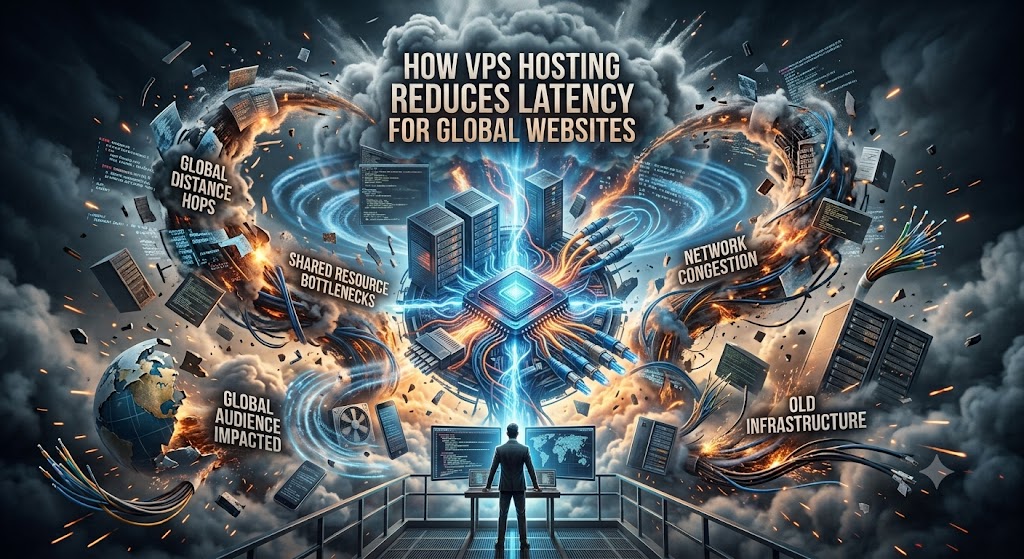
How VPS Hosting Reduces Latency for Global Websites
1. Dedicated Resources Improve Response Time
In shared hosting, multiple websites share the same CPU and memory. When one website experiences traffic spikes, others slow down.
With VPS hosting:
- CPU, RAM, and storage are dedicated
- No “noisy neighbor” problem
- Faster request processing
This leads to quicker server responses and lower latency, especially during high-traffic periods.
2. Strategic Server Location Selection
One of the pros of VPS web hosting is that you can choose server locations.
Through the use of VPS servers that are located nearer to your target clients:
- The data has to travel a shorter distance.
- Network hops are fewer
- Latency decreases drastically
For international sites, you can locate VPS servers in different parts of the world, such as Asia, Europe, and North America, to serve users effectively.
3. Superior Network Infrastructure and Routing
Most VPS hosting providers make use of the following:
- High-speed SSD or NVMe storage
- Premium bandwidth
- Optimized network routing
This ensures that data packets always take the most effective path, reducing any chances of delays in transmission and mislaid packets, major contributors to latency.
4. Enhanced Caching at the Server Level
VPS hosting allows you to set up advanced caching mechanisms, including:
- Caching at the object level using Redis, Memcached
- Opcode caching
- Full-page caching
Because these caching tools run directly on your VPS, they deliver content faster than shared hosting environments where customization is limited.
5. Consistent Performance Under Load
Global applications are often subjected to unpredictable traffic patterns. VPS hosting latency handles these scenarios better because
- Resources are set aside
- Performance does not change
- Latency doesn’t spike during surges of traffic
This is critical because there are websites that are accessed simultaneously by users from different parts of the world.
VPS Hosting vs Shared Hosting: Latency Comparison
| Feature | Shared Hosting | VPS Hosting |
|---|---|---|
| Resource Allocation | Shared | Dedicated |
| Performance Stability | Low | High |
| Latency Control | Limited | Advanced |
| Server Configuration | Restricted | Full Control |
| Scalability | Limited | Flexible |
Shared hosting may work for small local websites, but for global platforms, VPS hosting is far more efficient in reducing latency.
Role of VPS Hosting in Global Applications
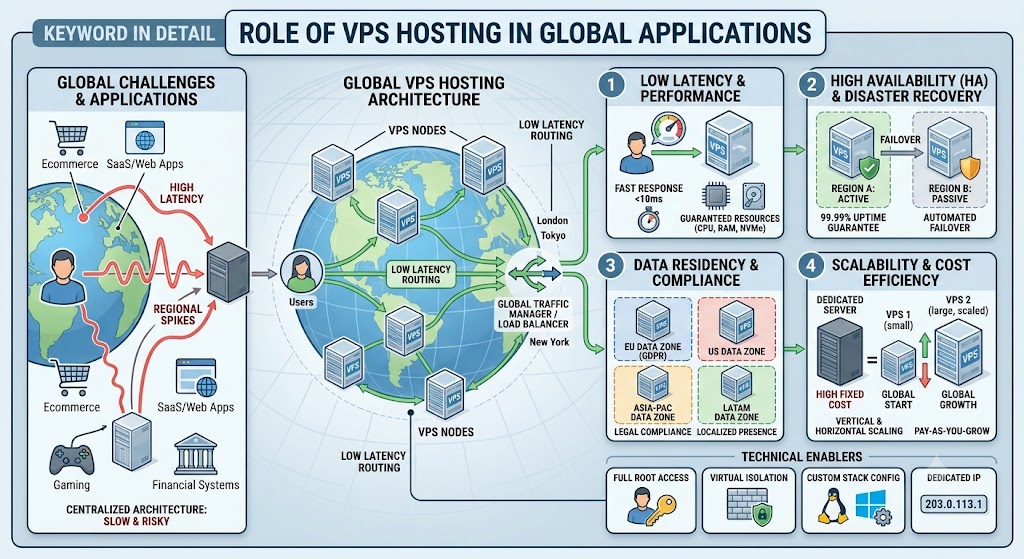
1. SaaS Platforms
SaaS applications rely on real-time interactions.
- Faster API responses
- Reduced session delays
- Better user retention
2. eCommerce Websites
Global eCommerce stores benefit from:
- Faster product page loading
- Quick checkout processing
- Improved customer trust
3. Gaming and Streaming Applications
Low latency is critical for:
- Multiplayer gaming
- Video streaming
- Live interactions
Low latency VPS hosting provides the stable, low-latency environment these applications require.
VPS Hosting and Content Delivery Networks (CDNs)
VPS hosting is highly efficient if combined with a CDN.
How this combination brings down latency:
- VPS berfungsi sebagai server asal yang sangat berdaya
- The CDN caches content worldwide in edge servers.
- Data is received by users from the nearest nodes
This hybrid configuration leads to a marked enhancement in performance for the global audience.
Custom OS & Software Optimization
In VPS hosting, you can control completely:
- Operating System Selection
- Web server configuration (Nginx, Apache, LiteSpeed
- PHP, Node.js, or Python variants
Improved software stacks cut down processing delays, resulting in faster execution speeds.
Reduces Network Congestion
Shared hosting platforms may have issues related to network congestion as different users are utilizing the same network connectivity.
Reduces such issues as:
- Ensuring assigned bandwidth
- Providing isolated network resources
- Guaranteeing Stable Data Transfer Speeds
This, in turn, makes a direct contribution to improved global performance.
Scalability Without Downtime
Because it’s older technology, infrastructure can’t always scale to accommodate growing global traffic, which increases latency.
allows:
- Easy upgrading of resources
- Vertical scaling, no migration
- Performance improvements without downtime
This ensures latency remains low even as user demand goes up.
Security Improvements That Indirectly Reduce Latency
Security issues like DDoS attacks or malware infections can slow servers dramatically.
improves security through:
- Isolated environments
- Custom firewall rules
- Advanced monitoring
A secure server runs efficiently, indirectly helping maintain low latency.
Real-World Example: Global Business Website
Consider a business serving customers in India, Europe, and the USA:
- Shared hosting struggles with distant users
- Page load times vary widely
- Customer experience becomes inconsistent
By switching to VPS hosting with regional servers or CDN integration:
- Latency is reduced globally
- Page load times become consistent
- User engagement improves
When Should You Choose VPS Hosting for Latency Reduction?
VPS hosting is ideal if:
- Your audience is international
- Your website or app handles real-time data
- Performance directly impacts revenue
- Shared hosting feels slow or unstable
For startups, growing businesses, and enterprises alike, VPS hosting is a performance-focused upgrade.
Final Thoughts
Latency is one of the most underestimated factors that influence global website and application performance. With growing user expectations and increased competition, slow-loading platforms cannot survive for long. Speed and responsiveness are no longer niceties; they are imperatives.
It greatly reduces delays by offering dedicated hosting resources, ideally optimized server locations, high-performance network infrastructure, and full control over system optimization. Along with advanced performance technologies like caching solutions or CDNs, the foundation becomes a strong one for delivering fast, reliable digital experiences.
If your aim is a world-class website or web application, a truly fast and responsive one, regardless of where the users are located, then this hosting approach becomes not so much an option as it does a necessity.
FAQs
1. What is latency in web hosting?
Latency is the time it takes for data to travel from a user’s device to the server and back. Lower latency means faster website or application response.
2. How does VPS hosting reduce latency?
VPS hosting provides dedicated resources, better network performance, and faster server response times, which significantly reduce delays compared to shared hosting.
3. Is VPS hosting better than shared hosting for global websites?
Yes, VPS hosting is much better for global websites because it offers stable performance, server location flexibility, and improved speed for international users.
4. Does server location affect latency?
Yes, server location plays a major role in latency. Hosting your VPS closer to your target audience reduces the physical distance data must travel, lowering latency.
5. Can VPS hosting handle high traffic without increasing latency?
Yes, VPS hosting handles traffic spikes more efficiently because resources are dedicated, preventing slowdowns during high-traffic periods.
6. Is VPS hosting suitable for global applications and SaaS platforms?
Absolutely. VPS hosting is ideal for global applications, SaaS platforms, and APIs that require fast, consistent, and low-latency performance.
7. How does VPS hosting work with a CDN to reduce latency?
VPS hosting acts as a powerful origin server while a CDN delivers cached content from the nearest global locations, drastically reducing latency for users worldwide.
8. Does VPS hosting improve SEO through lower latency?
Yes, faster load times and lower latency improve user experience, which helps search engine rankings and overall SEO performance.
9. Can I optimize software on VPS hosting to further reduce latency?
Yes, VPS hosting allows full control over server configurations, caching tools, and software stacks, enabling advanced optimization for even lower latency.
10. When should I upgrade to VPS hosting for latency improvement?
You should upgrade to VPS hosting if your website or application has global users, experiences performance issues, or requires faster and more reliable response times.
Suggestions:
- https://mainvps.net/blog/lifetime-web-hosting-2026/
- https://mainvps.net/blog/windows-reseller-web-hosting/
- https://mainvps.net/blog/best-wordpress-hosting-providers/
- https://mainvps.net/blog/linux-vps-hosting-india/
- https://mainvps.net/blog/low-cost-windows-vps-hosting-in-india/
- https://mainvps.net/blog/cheap-dedicated-server-hosting-providers/
- https://mainvps.net/blog/windows-server-guide-dde-dns-tls-1-2-uptime/
- https://mainvps.net/blog/dedicated-server-hosting-netherlands/
- https://mainvps.net/blog/dedicated-server-low-price/
- https://mainvps.net/blog/vps-hosting-in-los-angeles-us/
- https://mainvps.net/blog/dedicated-server-in-nedzone-nl/
- https://mainvps.net/blog/buy-linux-vps-hosting/
- https://mainvps.net/blog/managed-windows-vps-hosting/
- https://mainvps.net/blog/what-is-wmi-provider-host-complete-guide/
- https://mainvps.net/blog/cloud-hosting-vs-vps-2026/
- https://mainvps.net/blog/vps-hosting-for-ecommerce-guide/
- https://mainvps.net/blog/vps-hosting-for-saas-applications/
- https://mainvps.net/blog/vps-reseller-hosting-in-netherlands/
- https://mainvps.net/blog/dedicated-server-hosting-in-us/
- https://mainvps.net/blog/linux-reseller-hosting/
- https://mainvps.net/blog/best-windows-vps-providers-in-the-usa/
- https://mainvps.net/blog/unmanaged-dedicated-server-hosting/
- https://mainvps.net/blog/bellwright-dedicated-server/
- https://mainvps.net/blog/ark-survival-ascended-dedicated-server/
- https://mainvps.net/blog/kvm-vps-netherlands/
- https://mainvps.net/blog/cheap-reseller-hosting-india/
- https://mainvps.net/blog/linux-kvm-vps-hosting/