
When choosing the right hosting solution for your website or application, one of the most common comparisons is Virtual Dedicated Server vs Dedicated Server. Both hosting options deliver significantly better performance than shared hosting, but they differ in resource allocation, scalability, cost, and overall capabilities.
Whether you’re launching an eCommerce store, business website, SaaS platform, gaming server, or enterprise application, selecting the right server can have a major impact on your website’s speed, security, and user experience. This guide explores the key differences, advantages, and ideal use cases to help you choose the best hosting solution for your needs.
What Is a Virtual Dedicated Server?
“Virtual Dedicated Server” (VDS) refers to a virtualized server built on a physical server using advanced virtualization technologies. In contrast to VPS hosting services, where there is shared usage of the kernel by several clients, VDS provides the exclusive use of virtual resources like processors, memory, etc.
While there are several virtual servers built on one physical server, each VDS acts separately and has its own OS and allocated resources.
Key characteristics include the following:
- Dedicated virtual CPU cores
- Guaranteed RAM allocation
- SSD or NVMe storage
- Root or administrator access
- Independent operating system
- High scalability
- Lower cost than physical dedicated servers
Businesses often choose VDS hosting because it delivers excellent performance while remaining affordable.
What Is a Dedicated Server?
A dedicated server is a physical server that is dedicated completely to a single user. In contrast to virtualized hosts, there are no shared hardware resources involved.
Each of the resources, such as processors, RAM, hard drives, and bandwidth, is used solely by one customer.
Dedicated servers provide ultimate performance, hardware control, flexibility, and reliability.
These servers are commonly used for:
- High-traffic websites
- Enterprise applications
- Large databases
- Streaming services
- Game hosting
- Financial applications
- Government projects
- AI and machine learning workloads
Because no resources are shared, dedicated servers provide unmatched performance consistency.
Virtual Dedicated Server vs Dedicated Server: Quick Comparison
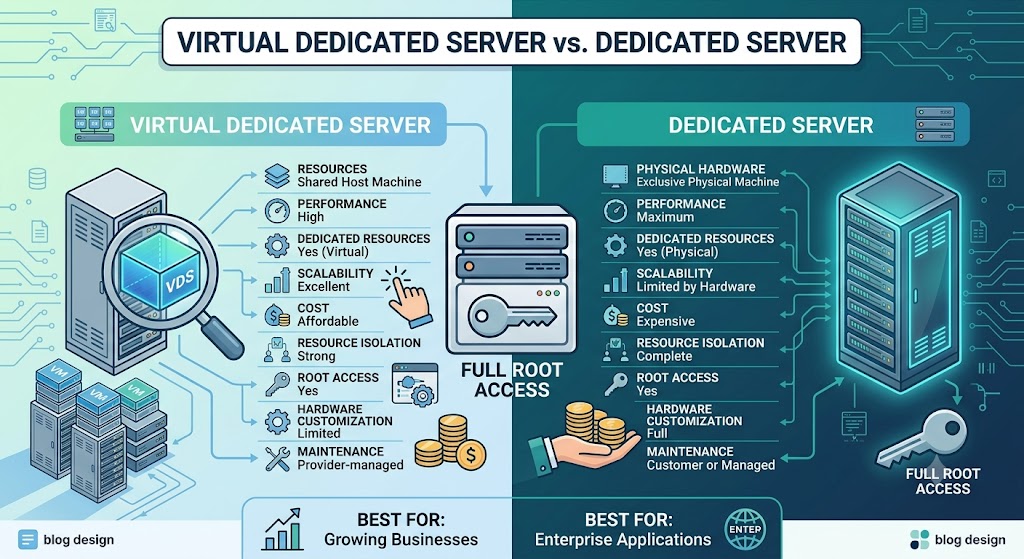
| Feature | Virtual Dedicated Server | Dedicated Server |
|---|---|---|
| Physical Hardware | Shared Host Machine | Exclusive Physical Machine |
| Performance | High | Maximum |
| Dedicated Resources | Yes (Virtual) | Yes (Physical) |
| Scalability | Excellent | Limited by Hardware |
| Cost | Affordable | Expensive |
| Resource Isolation | Strong | Complete |
| Root Access | Yes | Yes |
| Hardware Customization | Limited | Full |
| Maintenance | Provider-managed | Customer or Managed |
| Best For | Growing Businesses | Enterprise Applications |
Understanding the Main Difference
The primary difference between a virtual dedicated server vs a dedicated server lies in how the resources are allocated.
A virtual dedicated server uses virtualization software to divide one physical machine into several isolated virtual servers.
A dedicated server provides one entire physical machine exclusively to a single customer.
While both offer dedicated resources, only a dedicated server gives you exclusive ownership of the hardware.
Performance Comparison
Performance is often the deciding factor when choosing between these hosting options.
Virtual Dedicated Server Performance
Modern virtualization platforms such as KVM and VMware deliver outstanding performance.
Benefits include:
- Fast SSD storage
- Dedicated CPU allocation
- Guaranteed RAM
- Low latency
- Stable website performance
- High uptime
For most business websites, VDS performance is more than sufficient.
Dedicated Server Performance
Dedicated servers eliminate virtualization overhead entirely.
Advantages include:
- Entire processor available
- Maximum disk performance
- No noisy neighbors
- Better database handling
- Superior multitasking
- Consistent workload management
Dedicated servers are ideal for applications requiring continuous heavy processing.
Resource Allocation
Virtual Dedicated Server
Resources are reserved virtually.
For example:
- 8 CPU cores
- 16 GB RAM
- 250 GB NVMe SSD
These resources remain dedicated to your virtual machine.
Dedicated Server
Everything belongs exclusively to you.
Example:
- Intel Xeon Processor
- 64 GB ECC RAM
- Multiple NVMe SSDs
- RAID Storage
- Dedicated Network Port
No other customer shares any hardware resources.
Scalability
Scalability determines how easily your hosting can grow with your business.
Virtual Dedicated Server
One of the biggest strengths of VDS hosting is easy upgrades.
You can often increase:
- RAM
- CPU cores
- Disk space
- Bandwidth
Most upgrades require minimal downtime.
Dedicated Server
Scaling a physical server usually involves:
- Hardware upgrades
- Memory installation
- Processor replacement
- Disk migration
These upgrades may require planned maintenance and downtime.
Security Comparison
Security is critical for business websites and sensitive applications.
Virtual Dedicated Server Security
Modern virtualization technologies provide excellent isolation between virtual machines.
Security features include the following:
- Firewalls
- Private networking
- DDoS protection
- Regular backups
- Access control
- Operating system updates
For most organizations, VDS security is highly reliable.
Dedicated Server Security
Dedicated servers offer the highest level of hardware isolation.
Advantages include:
- No shared hardware
- Complete control over firewall policies
- Custom security software
- Hardware encryption
- Advanced compliance support
Industries such as banking, healthcare, and government often prefer dedicated servers.
Customization
Virtual Dedicated Server
You can customize:
- Operating system
- Control panel
- Web server
- Database server
- Security tools
- Software stack
However, hardware customization is limited.
Dedicated Server
Dedicated hosting provides complete flexibility.
You can choose:
- Processor model
- RAM size
- RAID configuration
- SSD or HDD
- GPU
- Network interface
- Operating system
This level of customization makes dedicated servers ideal for specialized workloads.
Cost Comparison
Pricing is one of the biggest differences in the virtual dedicated server vs. dedicated server comparison.
Virtual Dedicated Server
Generally includes:
- Lower monthly costs
- Flexible plans
- Affordable upgrades
- Excellent value
Suitable for startups and growing businesses.
Dedicated Server
Typically costs more because you receive an entire physical server.
Higher pricing reflects the following:
- Exclusive hardware
- Premium performance
- Enterprise reliability
- Greater customization
For organizations that depend on maximum performance, the investment is often worthwhile.
Management Options
Both hosting types are available in managed and unmanaged versions.
Managed Hosting
The provider handles:
- Updates
- Security patches
- Monitoring
- Backups
- Technical support
- Performance optimization
Ideal for businesses without in-house server administrators.
Unmanaged Hosting
You manage:
- Installation
- Configuration
- Security
- Maintenance
- Troubleshooting
Suitable for experienced system administrators.
Which Hosting Is Faster?
In general:
- Dedicated servers perform best in terms of pure performance.
- Virtual dedicated servers have very good performance capabilities for business purposes.
For websites having a medium or heavy load, there will be no performance difference if the VDS is well-optimized. But if an application requires maximum possible performance, such as AI calculations or a huge database, then dedicated servers should be used.
Best Use Cases for Virtual Dedicated Servers
A virtual dedicated server is ideal for:
- Business websites
- eCommerce stores
- Corporate portals
- WordPress hosting
- Development environments
- SaaS startups
- Web applications
- Email hosting
- Small databases
It offers a great balance between performance and affordability.
Best Use Cases for Dedicated Servers
A dedicated server is recommended for:
- Enterprise software
- High-traffic websites
- Gaming servers
- Streaming platforms
- Financial services
- Healthcare applications
- Government projects
- Large database servers
- Virtualization hosts
- AI and machine learning
These workloads benefit from dedicated hardware resources and maximum reliability.
Advantages of Virtual Dedicated Servers
Some major benefits include the following:
- Lower hosting costs
- Fast deployment
- Easy scalability
- Dedicated virtual resources
- High uptime
- Root access
- Excellent performance
- Flexible plans
- Simple upgrades
Advantages of Dedicated Servers
Dedicated hosting offers several premium benefits:
- Maximum computing power
- Complete hardware control
- Superior security
- No resource sharing
- Full customization
- Better compliance support
- Consistent performance
- Enterprise reliability
Disadvantages of Virtual Dedicated Servers
While VDS hosting is powerful, it has a few limitations:
- Hardware is still shared at the physical level.
- Limited hardware customization.
- Performance depends on the underlying host server.
- Extreme workloads may require physical hardware.
Disadvantages of Dedicated Servers
Dedicated servers also have some drawbacks:
- Higher monthly costs.
- Longer provisioning times.
- Hardware upgrades may require downtime.
- Greater responsibility for maintenance if unmanaged.
Virtual Dedicated Server vs Dedicated Server: Which Is Better?
It will depend on your business needs.
If you want a virtual dedicated server because:
- You require a more economical choice.
- You need dedicated resources without investing in an actual physical server.
- Your resource needs can potentially increase.
- Your websites, applications, or online shops have moderate to high traffic.
If you need a dedicated server because:
- You require maximum processing power.
- You need mission-critical applications.
- You need full hardware control.
- You have big databases or resource-intensive software.
Tips for Choosing the Right Hosting Solution
Before making a decision, consider the following factors:
Traffic Volume
Estimate your current and future website traffic. A VDS is suitable for most growing websites, while a dedicated server is better for consistently high traffic.
Budget
Factor in not only the monthly hosting cost but also expenses for management, backups, and future upgrades.
Technical Expertise
If you lack server administration experience, opt for a managed hosting plan to ensure your infrastructure is properly maintained.
Scalability
If rapid growth is expected, choose a hosting solution that allows seamless resource upgrades.
Performance Needs
Evaluate the resource demands of your applications. CPU-intensive, memory-heavy, or latency-sensitive workloads often perform best on dedicated hardware.
Security and Compliance
Businesses handling sensitive customer information should choose a solution that aligns with their security and regulatory requirements.
Conclusion
In the case of a virtual dedicated server vs. a dedicated server, the answer is not one size fits all. Both options are more powerful in terms of performance and security, but these servers are meant to suit various needs of businesses.
A virtual dedicated server is great for startups, developers, agencies, and any growing company that requires dedicated resources, flexibility, and, at the same time, cost-effectiveness. It provides good performance and scalability capabilities without expensive hardware.
On the contrary, a dedicated server with DDoS protection is for enterprises and companies that have important applications to run or databases or other heavy-duty processes.
Frequently Asked Questions
1. Is a virtual dedicated server the same as a VPS?
No. A Virtual Dedicated Server (VDS) provides better resource isolation and dedicated virtual resources than a standard VPS.
2. Which is more affordable, a virtual dedicated server or a dedicated server?
A virtual dedicated server is more affordable because it uses virtualized resources on shared physical hardware.
3. Can I upgrade from a virtual dedicated server to a dedicated server?
Yes. Most hosting providers offer easy migration from a VDS to a dedicated server.
4. Which hosting is better for eCommerce websites?
A VDS is ideal for most online stores, while a dedicated server is better for large, high-traffic eCommerce websites.
5. Is a dedicated server more secure?
Yes. A dedicated server offers complete hardware isolation and greater security.
6. Which option is easier to scale?
A virtual dedicated server is easier to scale, with quick upgrades for CPU, RAM, and storage.
7. Who should choose a Virtual Dedicated Server?
It is best for startups, small businesses, developers, and growing websites.
8. Who should choose a dedicated server?
It is ideal for enterprises, high-traffic websites, and resource-intensive applications.
9. Does a dedicated server perform better than a virtual dedicated server?
Yes. A dedicated server offers maximum performance with exclusive hardware resources.
10. How do I choose between a virtual dedicated server and a dedicated server?
Choose a VDS for affordability and flexibility or a dedicated server for maximum performance and control.
Suggestions:
- https://mainvps.net/blog/lifetime-web-hosting-2026/
- https://mainvps.net/blog/windows-reseller-web-hosting/
- https://mainvps.net/blog/best-wordpress-hosting-providers/
- https://mainvps.net/blog/linux-vps-hosting-india/
- https://mainvps.net/blog/low-cost-windows-vps-hosting-in-india/
- https://mainvps.net/blog/cheap-dedicated-server-hosting-providers/
- https://mainvps.net/blog/windows-server-guide-dde-dns-tls-1-2-uptime/
- https://mainvps.net/blog/dedicated-server-hosting-netherlands/
- https://mainvps.net/blog/dedicated-server-low-price/
- https://mainvps.net/blog/vps-hosting-in-los-angeles-us/
- https://mainvps.net/blog/dedicated-server-in-nedzone-nl/
- https://mainvps.net/blog/buy-linux-vps-hosting/
- https://mainvps.net/blog/managed-windows-vps-hosting/
- https://mainvps.net/blog/what-is-wmi-provider-host-complete-guide/
- https://mainvps.net/blog/cloud-hosting-vs-vps-2026/
- https://mainvps.net/blog/vps-hosting-for-ecommerce-guide/
- https://mainvps.net/blog/vps-hosting-for-saas-applications/
- https://mainvps.net/blog/vps-reseller-hosting-in-netherlands/
- https://mainvps.net/blog/dedicated-server-hosting-in-us/
- https://mainvps.net/blog/linux-reseller-hosting/
- https://mainvps.net/blog/best-windows-vps-providers-in-the-usa/
- https://mainvps.net/blog/unmanaged-dedicated-server-hosting/
- https://mainvps.net/blog/bellwright-dedicated-server/
- https://mainvps.net/blog/ark-survival-ascended-dedicated-server/
- https://mainvps.net/blog/kvm-vps-netherlands/
- https://mainvps.net/blog/cheap-reseller-hosting-india/
- https://mainvps.net/blog/linux-kvm-vps-hosting/