
The success of forex trading is greatly determined by the trader’s ability to maintain timing, stability, and speed of execution. The slightest disturbance in your internet connection or a computer system crash can negatively influence your automatic trading. That is why many traders opt for using a forex VPS (Virtual Private Server).
A forex VPS is a virtual server that will remain connected to the Internet and run a trading platform such as MT4 or MT5. You will not have to maintain your trading platform installed on your PC but rather on the VPS, which you will be able to access remotely at any time.
What is a forex VPS, how does it operate, and why use it? This article will answer all your questions.
What Is a Forex VPS?
A Forex VPS is a specialized virtual server that helps create a stable environment for operating trading terminals, Expert Advisors (EAs), indicators, scripts, and any other trading software.
In contrast to a regular computer that works from your home or office, a VPS is located in a professional data center where the server works all the time and is constantly connected to the Internet.
Let’s consider an example: you have an EA working in MT5 that should constantly work and carry out trades according to certain criteria. If you install MT5 on your computer and your computer switches off or disconnects from the Internet, the EA will stop operating.
But if you use a Forex VPS, MT5 will be running on the remote server, and you can observe its operation from anywhere using your laptop, desktop, or smartphone.
How a Forex VPS Works
The basic process is straightforward:
- You purchase a VPS plan from a provider.
- The provider creates your virtual server.
- You connect to the VPS remotely.
- You install your trading platform, such as MT4 or MT5.
- You install your EAs, indicators, or trading tools.
- You keep the trading platform running on the VPS.
- The server remains online and connected to the internet.
You do not need to keep your own computer switched on 24/7.
Why Do Forex Traders Use a VPS?
Forex markets can move quickly, and automated strategies may need to operate continuously. A VPS can provide a more consistent environment for trading applications.
Here are some of the main reasons traders use a forex trading VPS.
1. 24/7 Trading Platform Availability
Continuity is one of the key benefits offered by a VPS.
The forex market trades across global financial markets and usually runs around the clock on weekdays. Traders who use automation techniques may wish for their systems to run uninterrupted.
A VPS will be able to ensure that your MT4, MT5, or another suitable platform remains up and running even when your computer is off.
This is especially important for expert advisors, which have been coded to look at chart patterns and trade as per the rules that have been preset into them.
2. Better Stability
Your home computer is prone to numerous disruptions. Blackouts, operating system updates, Wi-Fi issues, router resets, and unexpected shutdowns can all affect your trading software.
Moving the trading platform to a virtual private server shifts it to a professionally managed server environment.
It cannot guarantee perfect uptime from each VPS service provider, but a quality one usually provides a reliable infrastructure and network connectivity.
3. Lower Latency
Latency is the time needed for transferring information between your trading platform and your broker’s server.
There are certain types of trading techniques where lower latency may play a role, especially automated and high-frequency trading systems.
Choosing a Forex VPS server located near your broker’s infrastructure can decrease the network distance between your trading software and your broker’s server.
Nevertheless, low latency does not depend solely on the location of the VPS, and there are a number of different factors.
4. Supports Automated Trading
Forex VPS Server is particularly popular among traders who use automated trading systems.
An expert advisor can monitor market conditions and execute trades based on programmed rules. For this to work correctly, the trading platform needs to remain active.
Running the EA on a VPS means it can continue operating without relying on your personal computer.
This is useful for strategies that:
- Monitor markets continuously
- Use automated entry and exit rules
- Manage open positions
- Track price levels
- Run scheduled trading actions
- Use multiple indicators
- Operate across multiple currency pairs
5. Remote Access
You may have remote access to a VPS using various devices and locations.
You will be able to log into your server from a laptop, desktop, and mobile device if you have one and control your trading environment remotely.
This way, even though you used to use MT5 on your office computer, now you can log in to the same VPS without being at your computer.
Forex VPS vs Regular VPS
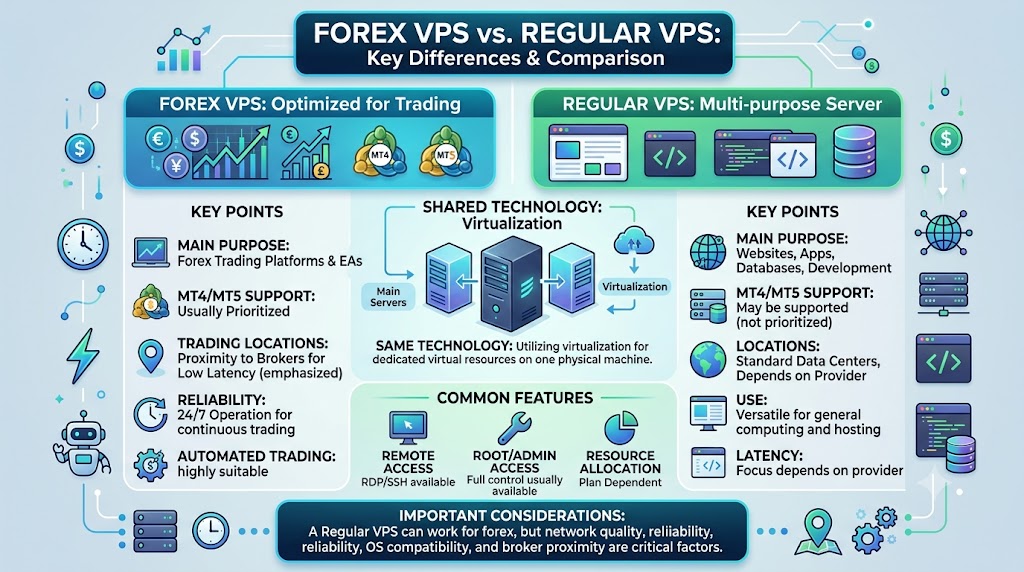
A Forex VPS is not necessarily an entirely different technology than a regular VPS. Both are technologies utilizing virtualization, which allows access to dedicated virtual resources hosted on one physical machine.
The main distinction between the two technologies lies in the configuration and marketing of VPS.
VPS in general may be configured for websites, applications, databases, or development. A VPS for forex trading would mostly be tailored to the demands of trading platforms.
| Feature | Forex VPS | Regular VPS |
| Main purpose | Forex trading platforms | Websites, apps, development, etc. |
| MT4/MT5 support | Usually prioritized | May be supported |
| Trading-focused location options | Often available | Depends on provider |
| 24/7 operation | Yes | Yes |
| Remote access | Yes | Yes |
| Automated trading | Suitable | Can be suitable |
| Low-latency focus | Often emphasized | Depends on provider |
| Root/admin access | Usually available | Usually available |
| Resource allocation | Plan dependent | Plan dependent |
| Windows options | Common | Provider dependent |
A regular VPS can sometimes work perfectly well for forex trading. The important factors are server resources, operating system compatibility, network quality, reliability, and proximity to your broker.
Forex VPS vs Home Computer
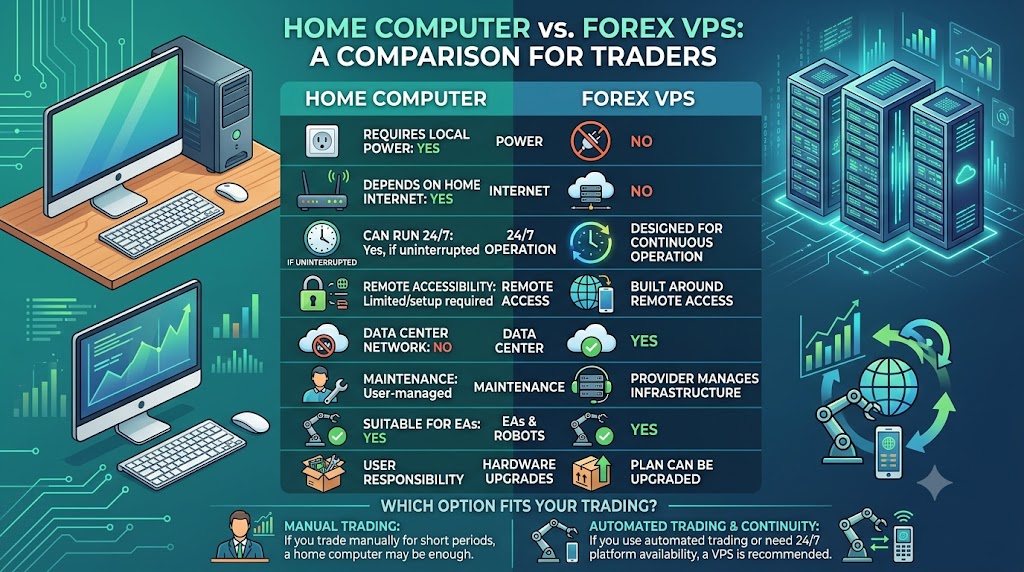
A home computer is perfectly capable of running MT4 or MT5 for many traders. The difference is that a VPS is designed to remain available remotely and continuously.
| Factor | Home Computer | Forex VPS |
| Requires local power | Yes | No |
| Depends on home internet | Yes | No |
| Can run 24/7 | Yes, if uninterrupted | Designed for continuous operation |
| Remote accessibility | Limited/setup required | Built around remote access |
| Data center network | No | Yes |
| Maintenance | User-managed | Provider manages infrastructure |
| Suitable for EAs | Yes | Yes |
| Hardware upgrades | User responsibility | Plan can usually be upgraded |
If you only trade manually for short periods, a VPS may not be necessary. If you use automated trading or need your platform available continuously, a VPS can be much more useful.
What Can You Run on a Forex VPS?
A Forex VPS can host many types of trading software, depending on its operating system and available resources.
MetaTrader 4
MT4 remains widely used by forex traders and supports expert advisors, custom indicators, scripts, and automated strategies.
MetaTrader 5
MT5 provides additional trading functionality and is also commonly installed on VPS servers.
Expert Advisors
Expert Advisors automate trading decisions according to predefined programming logic. They require the trading platform to remain active if they are expected to monitor markets continuously.
Custom Indicators
Traders can install custom indicators on their VPS and use them with their trading platforms.
Multiple Trading Accounts
A sufficiently powerful VPS can run multiple MT4 or MT5 installations simultaneously. The exact number depends on CPU, RAM, storage, and the complexity of the trading applications.
Trading Scripts and Utilities
Scripts and supporting applications can also be hosted on a VPS when compatible with the server’s operating system.
Key Features to Look for in a Forex VPS
Not every VPS is equally suitable for trading. Before choosing a provider, consider the following features.
1. Low-Latency Network
Consider checking out the speed and reliability of the VPS network, as well as its locations. In the ideal case, the server would have to be relatively close to the broker’s trading system.
One shouldn’t choose a server based on geographical considerations. It would be much better to perform a test to measure latency to the broker’s server.
2. Sufficient RAM
The amount of RAM depends on the number of trading platforms, charts, indicators, and EAs that will be running.
For a simple one-platform setup, small RAM may suffice. More platforms and EAs increase the memory consumption.
3. Adequate CPU
CPU performance becomes more important when running multiple trading terminals or computationally demanding strategies.
If your VPS frequently reaches high CPU utilization, upgrading to a stronger plan may improve overall stability.
4. SSD or NVMe Storage
Fast storage can improve server responsiveness and application loading times. SSD storage is generally preferable to older mechanical drives, while NVMe can provide even faster storage performance.
5. Windows Compatibility
A number of trading platforms that can be used to trade forex are widely used on Windows. If you are planning to use MT4 or MT5 on Windows, ensure that the VPS package accommodates the necessary operating system.
6. Reliable Uptime
Your trading platform must function properly if your server is up.
Make sure you choose providers who offer clear information regarding their infrastructure, uptime policy, monitoring, and support services.
7. Backup and Recovery Options
There is always a chance that there might be any kind of issues with the software. Having backup and restoration options can help in restoring your environment if anything goes wrong.
8. Technical Support
Good technical support can be valuable when configuring remote desktop access, installing trading platforms, troubleshooting connectivity, or managing server resources.
How to Choose the Right Forex VPS
Choosing the right VPS starts with understanding your trading setup.
Ask yourself:
- How many trading platforms will I run?
- How many EAs will I use?
- How much RAM do my applications require?
- Does my broker have a preferred server location?
- Do I need Windows?
- Do I need root or administrator access?
- How important is low latency for my strategy?
- How much storage do I need?
- Do I need technical support?
- What monthly budget am I comfortable with?
A trader running one MT4 terminal with a lightweight EA may need considerably fewer resources than someone running several MT5 terminals with multiple complex EAs.
How to Set Up a Forex VPS
Setting up a Forex VPS is generally straightforward.
Step 1: Select a VPS Plan
Choose a plan based on the number of platforms and applications you intend to run.
Step 2: Select the Operating System
For Windows-based trading platforms, select a compatible Windows VPS configuration.
Step 3: Choose the Data Center
Select a location that offers good network connectivity to your broker. If possible, test latency before committing to a long-term setup.
Step 4: Connect Through Remote Desktop
After the VPS is provisioned, you normally receive login credentials. Use a remote desktop client to connect to the server.
Step 5: Install MT4 or MT5
Download and install your preferred trading platform.
Step 6: Configure Your Trading Strategy
Log in to your trading account and install your EAs, indicators, scripts, and other required tools.
Step 7: Test Everything
Before relying on the VPS for live trading, test your platform and strategy. Confirm that EAs are running correctly and that charts, indicators, and trading permissions are configured properly.
Step 8: Monitor the Server
Check CPU and RAM usage periodically. If your resources are consistently overloaded, consider upgrading the VPS.
Common Forex VPS Mistakes to Avoid
A VPS can improve the technical environment for trading, but poor configuration can still cause problems.
Choosing a VPS Only Because It Is Cheap
Price is important, but extremely cheap hosting may come with limited resources, weaker support, or poor network performance.
Instead of focusing only on price, compare performance, reliability, location, resources, and support.
Ignoring Broker Location
A VPS in a distant data center may introduce unnecessary network latency.
Choose a location based on your broker’s infrastructure and actual connectivity rather than simply selecting a country you prefer.
Running Too Many Platforms
A small VPS may struggle if you run numerous MT4/MT5 terminals, EAs, charts, and background applications simultaneously.
Monitor resource consumption before adding more workloads.
Not Testing Your EA
Never assume an EA will work perfectly after installation. Test its behavior, permissions, settings, and resource usage before depending on it.
Forgetting About Security
Your VPS contains trading account credentials and potentially valuable software configurations.
Use strong passwords, keep the operating system updated, restrict unnecessary access, and follow good server security practices.
Is a Forex VPS Necessary for Every Trader?
No, not every trader needs a Forex VPS.
If you trade manually and only use your trading platform for a few hours each day, you may not need one. You can simply open your platform when you want to trade and close it when you’re finished.
A Forex VPS can be more useful for traders who use Expert Advisors (EAs), trading robots, automated strategies, or systems that need to run continuously. A VPS allows these tools to keep working even when your personal computer is turned off or disconnected from the internet.
So, whether you need a Forex VPS depends on how you trade and what your trading setup requires.
Advantages and Limitations of a Forex VPS
Advantages
- Continuous server availability
- Remote access
- Stable network environment
- Suitable for automated trading
- Reduced dependence on home internet
- No need to keep your personal computer running
- Potentially lower latency when located near the broker
- Easy to run multiple trading platforms with suitable resources
Limitations
- Additional monthly cost
- Requires some server management knowledge
- Poorly configured VPSs can still experience problems
- Latency is not automatically low
- VPS performance depends on allocated resources
- A VPS does not make an unprofitable trading strategy profitable
This final point is especially important. A VPS is infrastructure, not a trading strategy. It can help your software operate reliably, but it cannot guarantee trading profits.
Who Should Consider Using a Forex VPS?
A Forex VPS can be particularly useful for:
Automated traders: Traders running EAs can keep their platforms active without leaving a home computer switched on.
Algorithmic traders: Automated systems that monitor markets continuously can benefit from a persistent server environment.
Multi-account traders: A VPS with sufficient resources can simplify the management of several trading accounts.
Traders with unreliable internet: A VPS removes dependence on the trader’s local internet connection for the trading platform’s ongoing operation.
Traders who travel: Remote access allows traders to manage their server environment from different locations.
Final Thoughts
Using a Forex VPS could be a practical choice for traders who wish to keep their trading platform running without using a personal computer. It offers a remote environment where MT4, MT5, expert advisors, indicators, and other trading tools can run 24/7.
Manual traders could get by with a VPS. But for automated traders, it would be much more critical for the program to run 24/7. Using a suitable VPS could minimize the dependency on power and internet connection from one’s location while providing remote access and server capacity.
In choosing a VPS for Forex trading, price is not everything to consider. One should look into the latency, server location, CPU, RAM, storage capacity, uptime, security, scalability, and support. More than anything else, pick a server configuration based on your trading load.
Frequently Asked Questions
1. What is a Forex VPS?
A Forex VPS is a type of virtual private server that allows forex trading applications like MT4 and MT5 to be operated 24/7 from a remote data center location.
2. Why do traders use a Forex VPS?
Many traders choose to use VPS hosting because it allows trading applications and automated trading to operate without the trader’s computer and Internet connection at home.
3. Is a Forex VPS good for automated trading?
Indeed. VPS can offer a constant environment for automated trading applications like EAs and others.
4. Does a Forex VPS reduce trading latency?
It can, particularly when the VPS is located close to the broker’s infrastructure. However, actual latency depends on the network route and broker server location.
5. Can I run MT4 on a Forex VPS?
Yes. Many Forex VPS plans support MT4, although you should verify operating-system and software compatibility before purchasing.
6. Can I run MT5 on a VPS?
Yes, MT5 can be used on any VPS that supports it and remains operational when the trader’s personal computer is shut down.
7. Do I need a VPS for manual forex trading?
Maybe not, but a VPS can be more beneficial for traders who require constant platform accessibility or work with automated trading software.
8. Can a Forex VPS guarantee profits?
No, a VPS can only provide infrastructure and is unable to guarantee profitable trades or to make existing trading strategies better.
9. How much RAM does a Forex VPS need?
The needed RAM depends on the number of trading platforms, charts, EAs, and other applications the trader plans to work with.
10. How do I choose the best Forex VPS?
Compare the location, latency, CPU, RAM, storage, OS, uptime, security, scalability, and technical support of different VPS providers and choose the one that suits your needs.
Suggestions:
- https://mainvps.net/blog/lifetime-web-hosting-2026/
- https://mainvps.net/blog/windows-reseller-web-hosting/
- https://mainvps.net/blog/best-wordpress-hosting-providers/
- https://mainvps.net/blog/linux-vps-hosting-india/
- https://mainvps.net/blog/low-cost-windows-vps-hosting-in-india/
- https://mainvps.net/blog/cheap-dedicated-server-hosting-providers/
- https://mainvps.net/blog/windows-server-guide-dde-dns-tls-1-2-uptime/
- https://mainvps.net/blog/dedicated-server-hosting-netherlands/
- https://mainvps.net/blog/dedicated-server-low-price/
- https://mainvps.net/blog/vps-hosting-in-los-angeles-us/
- https://mainvps.net/blog/dedicated-server-in-nedzone-nl/
- https://mainvps.net/blog/buy-linux-vps-hosting/
- https://mainvps.net/blog/managed-windows-vps-hosting/
- https://mainvps.net/blog/what-is-wmi-provider-host-complete-guide/
- https://mainvps.net/blog/cloud-hosting-vs-vps-2026/
- https://mainvps.net/blog/vps-hosting-for-ecommerce-guide/
- https://mainvps.net/blog/vps-hosting-for-saas-applications/
- https://mainvps.net/blog/vps-reseller-hosting-in-netherlands/
- https://mainvps.net/blog/dedicated-server-hosting-in-us/
- https://mainvps.net/blog/linux-reseller-hosting/
- https://mainvps.net/blog/dedicated-server-with-nvme-us/
- https://mainvps.net/blog/dedicated-server-with-root-access-us/
- https://mainvps.net/blog/dedicated-server-with-cpanel-us/
- https://mainvps.net/blog/litespeed-vps-hosting-in-netherlands/
- https://mainvps.net/blog/cheap-windows-vps-hosting/
- https://mainvps.net/blog/affordable-dedicated-server-netherlands/
- https://mainvps.net/blog/us-windows-vps-hosting/
- https://mainvps.net/blog/dedicated-server-hosting-services-in-the-us/
- https://mainvps.net/blog/cloud-servers-for-small-business/
- https://mainvps.net/blog/low-cost-dedicated-server-usa/