
If you’ve spent any real time in forex VPS or algorithmic trading communities, you’ve probably come across the term “VPS” more than once. Maybe a fellow trader mentioned it in passing, or a broker’s website recommended it for running expert advisors. For a lot of traders, it sounds like just another piece of tech jargon to ignore. But once you understand what a VPS for Trading actually does for your trading, it’s hard to imagine going back to a regular home setup.
A VPS, or Virtual Private Server, has quietly become one of the most important tools in a serious trader’s kit. It’s not flashy. It doesn’t promise higher win rates or magic signals. What it does is far more practical: it keeps your trading running smoothly, reliably, and without interruption, no matter what’s happening on your end of the internet connection.
In this article, we’ll walk through what a trading VPS is, why it matters for forex and algorithmic trading, and how to choose one that fits your needs.
What Is a VPS for Trading?
The virtual private server (VPS) represents just a slice of a powerful remote computer that you lease and operate as if it belongs to you. Instead of running the trading platform from your laptop/desktop at home, you install the platform on the remote server that resides in a professional data center and operates 24/7.
Once your trading platform, which might be MetaTrader 4, MetaTrader 5, cTrader, or any algorithmic setup, is installed and operating on the VPS, you can safely shut down your laptop/desktop or even disconnect from the Internet completely, and your trades continue executing exactly according to your algorithm. All you need to do is connect back when you want to check what happened.
From the technical point of view, there is no difference between the trading VPS and any other VPS used to host a website or an application. The only difference is that a trading VPS is optimized in some particular way to be suitable for trading.
Why Traders Need a VPS in the First Place
Trades are not done within a set time frame such as 9-to-5. The foreign exchange market works for twenty-four hours in the week in which it works across several sessions in Sydney, Tokyo, London, and New York. The prices may change drastically at any time, and if you have an automated system and you have opened some trades that require manual control, going offline at the wrong moment may prove very expensive.
Consider what happens at home. You get a problem with your internet service provider. Your electricity supply is disrupted during a storm. The operating system on your computer installs an update and reboots. Your laptop battery runs out of charge when you are away. Any of these events is quite possible and is capable of interfering with your trading platform at the worst possible time: missing the entry point, failing to close your position, or stopping the automated system from running its course.
With a VPS, all these things do not matter since your computer runs independently of what is going on in your house.
Benefits of VPS for Trading
1. 24/7 Trading Platform Availability
One of the most significant advantages of VPS for Forex trading is continuous operation.
The stock market operates in various sessions, and Forex markets are usually open 24/7 on trading days. Traders who use automated programs may require their platforms to work beyond the scope of their regular working hours.
Your personal computer may not be an appropriate choice in this case. Electricity problems, software updates, shutting down by mistake, lack of Internet, or hardware failures can disturb your trading platform.
However, a VPS works in a data center and is supposed to work 24/7 without any stoppages. It provides your MT4, MT5, Expert Advisor, or trading program the ability to keep working even if your personal computer is switched off.
It will be especially beneficial for automated traders because they can keep using their strategies according to the set rules.
2. Reliable Internet Connectivity
The stability of the Internet is critical in online trading platforms.
If the Internet connection at home becomes disconnected, then the trading platform will have difficulty communicating with the broker’s server. This will depend on how the trading platform has been configured.
A professional environment like a VPS will usually offer more stable network connections than the average home environment.
It does not ensure the perfection of the trade since there are many elements that influence the performance of the trade, such as the broker’s infrastructure, the market conditions, network routing, and the process of order processing. The relocation of the trading platform to the data center will eliminate one possible cause of interruptions: an unstable Internet connection.
3. Lower Latency Can Improve Responsiveness
Latency is defined as the amount of time taken by data to move from one system to another.
In the case of a trader, network latency can be affected by the physical distance between the VPS, trading software, and the infrastructure of the broker. This is because the use of a VPS that is closer to the broker’s server can make the network path shorter.
It is especially important to take into account network latency when it comes to strategies that rely on quick communications, such as some types of algorithmic and high-frequency trading.
However, it is worth noting that just buying a VPS does not mean that the latency will become low. The location of the VPS is also important in this regard.
4. Better Environment for Automated Trading
Automated trading systems require a continuously running platform.
Expert Advisors, trading bots, scripts, and algorithmic systems may need to monitor market conditions and respond according to predefined rules. If the computer hosting these applications shuts down, the system may stop working.
A VPS allows the trading environment to remain active without requiring a physical desktop or laptop to stay powered on.
For example, an algorithmic trader could configure:
- MetaTrader 5
- Multiple Expert Advisors
- Several currency pairs
- Custom indicators
- Automated risk-management scripts
All of these applications can operate from the VPS while the trader monitors them remotely.
This makes a VPS especially useful for traders who do not want to keep their personal computer running throughout the trading week.
5. Remote Access From Almost Anywhere
Other practical benefits include accessibility.
The VPS can be accessed remotely, meaning that traders have the ability to control their trading environment without needing to be physically near their primary computer.
For instance, if you trade from an office but must leave for some reason, you don’t need to transfer everything to a new computer; rather, you can log into your VPS remotely.
When you log into your VPS, you will have the ability to see your trading station, check Expert Advisors, configure the system, install software, read logs, and carry out other administrative functions.
6. Reduced Dependence on Personal Hardware
Personal computers are not designed specifically to provide uninterrupted server availability.
A desktop or laptop can experience:
- Hardware failures
- Power cuts
- Internet outages
- System updates
- Overheating
- Software crashes
- Accidental shutdowns
Any of these events can interrupt a trading platform.
With a VPS, the trading environment is separated from your local computer. Your computer essentially becomes the device you use to access the remote server rather than the machine responsible for keeping the trading platform online.
This can make the overall setup more convenient and resilient.
VPS for Forex Trading
VPS hosting is one of the most commonly used hosting types for forex traders since forex VPS trading strategies require trading platforms to be always online.
MetaTrader 4 and MetaTrader 5 are popular among Forex traders, and both platforms provide opportunities to use automated trading services via Expert Advisors.
A forex trader who uses an Expert Advisor may wish to have his or her platform active for the whole week of trading. With VPS hosting, the user can achieve that without having to leave his or her own computer turned on all the time.
For instance, let us consider a forex trader who uses an EA that tracks GBP/USD and USD/JPY according to certain technical criteria. He or she would need the MetaTrader platform to stay online constantly.
If he or she hosts the MT5 platform on a VPS, then it will be able to work even when the trader’s home PC is off.
VPS for Algorithmic Trading
Algorithmic trading involves using computer programs or predefined rules to analyze market conditions and potentially generate trading actions.
These systems can range from relatively simple Expert Advisors to sophisticated applications using APIs, Python, databases, and custom trading infrastructure.
A VPS provides an environment where these applications can run continuously.
For algorithmic traders, important VPS characteristics can include:
- CPU performance
- RAM availability
- SSD or NVMe storage
- Network stability
- Operating system compatibility
- Server location
- Scalability
- Remote administration
- Backup options
The right configuration depends on the complexity of the trading software.
A simple MT4 Expert Advisor may require relatively modest resources, while a trader running several platforms, data-processing applications, and custom algorithms may require more CPU and RAM.
How a VPS Can Help Expert Advisors
Expert Advisors are automated programs that run inside MetaTrader.
Once an EA is configured, it can monitor selected markets based on its programming. However, an EA can only operate while the relevant trading platform and computing environment are running.
This is where a VPS becomes useful.
A typical setup might look like this:
VPS → Windows OS → MetaTrader → Expert Advisor → Broker Server
The VPS keeps the operating system and trading platform running. MetaTrader maintains its connection to the broker, while the EA operates according to its programmed strategy.
The trader can remotely access the VPS to monitor the system and make changes when necessary.
It is important to remember that a VPS cannot fix poorly designed trading software. If an EA contains coding errors or a strategy has poor risk management, moving it to a VPS will not solve those problems.
The VPS provides infrastructure, not trading intelligence.
Choosing the Right VPS for Algorithmic Trading
Not every VPS is equally suitable for trading, so it is important to look beyond price when choosing a provider. Traders should consider factors such as server location, CPU and RAM, storage technology, operating system, uptime, network reliability, and scalability. The right configuration depends on the type of trading platform, Expert Advisors, bots, and other applications you plan to run.
Server Location
The position of the server may have a direct effect on latency, which is an important factor for Forex traders and algotraders. If the broker’s network is situated in a certain part of the world, using a VPS data center that is closer to it will help minimize the distance through which the trading data is transmitted. On the other hand, it is not the only factor to be taken into account. The infrastructure of the data center and its network connections may also influence the latency.
CPU and RAM
The requirements for CPU and RAM capacity of a trading VPS will mainly depend on your needs. If you plan to operate just one MetaTrader terminal with some lightweight EA, then there is no need for a powerful system configuration. However, if you intend to have several MetaTrader terminals and EAs, indicators, bots, databases, and other applications for analysis, then there is a much higher need for higher CPU and RAM capacity. It will help you to maintain your trading environment efficiently and avoid any problems associated with the low capacity of your system. Still, it makes no sense to pay for something that you are not going to use.
SSD or NVMe Storage
VPS storage technology may also influence your VPS’s responsiveness. The SSD storage type provides much faster data read and write operations than traditional hard disks, while the NVMe SSDs provide even faster disk access. This feature becomes relevant when your VPS uses multiple applications, processes trading data, or handles large files. For basic VPS setups, which are used for trading, the storage capacity is not critical, and the priority is on the CPU, RAM, and the speed of networking. But selecting a VPS with the mentioned storage technologies will help you get a faster VPS.
Operating System
The choice of operating system must be compatible with the trading software and applications that you are using. The Windows VPS hosting option is a favored choice by many Forex traders since most trading platforms like MetaTrader 4 and MetaTrader 5 are used in Windows-based systems with an easy-to-use graphical interface. Linux VPS solutions are also an option for those who trade on a trading platform that is compatible with such software and applications, APIs, and algorithmic systems.
Uptime and Network Reliability
Constant connection is a key factor for conducting automated trading. In order to avoid sudden disconnections in your system, you should seek a VPS company with reliable infrastructure, a robust network, redundant systems, and quality data center facilities. Although no hosting company can give you 100 percent uptime guarantees, good maintenance of your infrastructure will go a long way in preventing any disruptions to your trading system. This becomes very important, especially for traders using expert advisors and algorithmic systems, which should be online constantly.
Scalability
Your need for a VPS may evolve depending on how successful you become as a trader. While you may begin with only one MetaTrader account and one EA, you may later decide to increase the number of accounts, EAs, and analysis tools you want to use. It is therefore essential to ensure your VPS is scalable, allowing you to increase CPU, memory, or storage if necessary. By doing so, you will be able to scale up your trading platform without transferring all of your resources to a different server.
VPS vs. Trading from a Home Computer
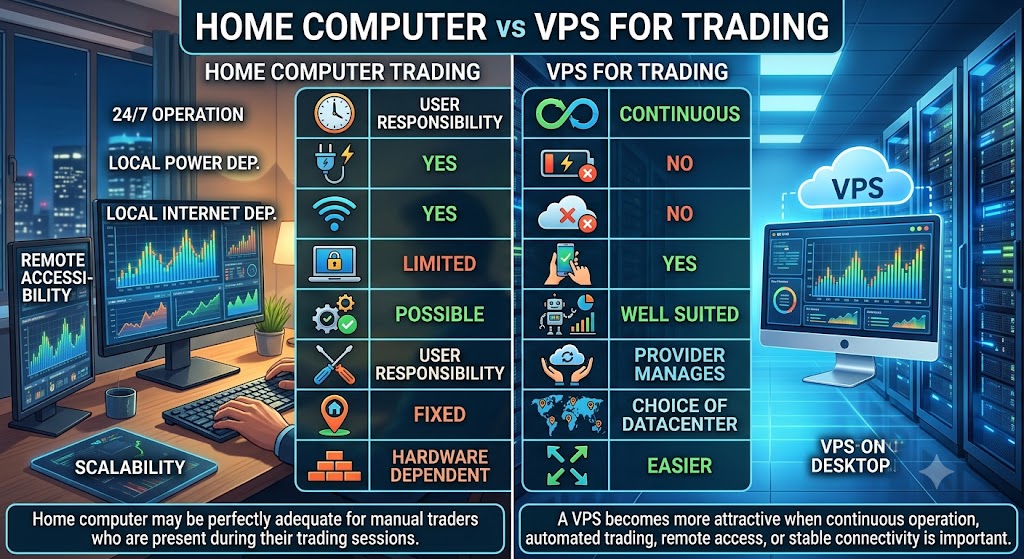
Both options can work, but they serve different needs.
| Feature | Home Computer | VPS for Trading |
|---|---|---|
| 24/7 operation | Depends on user | Designed for continuous operation |
| Local power dependency | Yes | No |
| Local internet dependency | Yes | No |
| Remote accessibility | Limited | Yes |
| Automated trading | Possible | Well suited |
| Hardware maintenance | User responsibility | Hosting provider manages infrastructure |
| Server location | Fixed | Choice of data center |
| Scalability | Hardware dependent | Usually easier |
A home computer may be perfectly adequate for manual traders who are present during their trading sessions.
A VPS becomes more attractive when continuous operation, automated trading, remote access, or stable connectivity is important.
Is a VPS Necessary for Every Trader?
No.
A VPS is not mandatory for every trading strategy.
If you manually place trades for a few hours each day and monitor your platform directly, a regular computer may be enough.
A VPS becomes more useful when you:
- Run Expert Advisors
- Use automated trading bots
- Need your platform active continuously
- Trade across different market sessions
- Want remote access
- Need a server near your broker
- Run multiple trading platforms
- Use algorithmic applications
The decision should be based on your trading setup and technical requirements.
Security Considerations for Trading VPS
Security must be a top concern when working with any remote server.
As a trading VPS can hold sensitive account data and trading tools, traders must apply some basic principles of security.
Use strong passwords and two-factor authentication where possible. Always keep your OS and apps up-to-date. Don’t install any unnecessary software, and try to access to the server only when you really need it.
Also, never give anyone your VPS credentials.
One more useful step is making backups of your configuration files, Expert Advisors, scripts, and other trading materials.
Keep in mind that the security of a VPS depends on both the hosting company and the client himself. The former is responsible for the server infrastructure, while the latter is responsible for the security of his server, credentials, and applications.
Common Mistakes When Using a Trading VPS
Even though using a VPS may increase the reliability and convenience of trading infrastructure, some mistakes can be made by traders while selecting or using a virtual private server. Among such mistakes, one may highlight:
Not Testing Trading Software: Using a newly installed Expert Advisor or other algorithms without testing them thoroughly in advance might increase the risk of losing money because it is always better to test trading software and configurations of VPS in order to minimize risks.
Lack of Proper Hardware Resources: Insufficient resources like low CPU and RAM may create difficulties in running several platforms, EAs, trading bots, or indicators simultaneously.
No Concern for Server’s Location: Using a VPS that is located far from the server of your broker might lead to additional network latency; thus, one needs to consider a data center that will provide an effective and reliable connection to your broker’s infrastructure.
Expecting Guaranteed Profitability: The VPS is an advanced hosting tool and does not represent any kind of trading strategy, which means that it does not provide any guarantees regarding profitability, high winning percentage, and successful execution of trades. All these aspects still depend on various conditions like market situation, spreads, liquidity, broker, and quality of a trading strategy.
Believing in Ideal Execution: Even though using a reliable VPS will certainly provide a trader with a stable environment, it will not remove all the factors that influence the process of trade execution.
Failing to Keep Track of the VPS: An automated trading system should not be launched and left alone. A trader needs to monitor various aspects like the platform’s log file, activity of the Expert Advisor, CPU and RAM consumption, and Internet connection.
How to Set Up a Forex Trading VPS
Creating the VPS for your trading needs is not difficult. The following are the steps that will help you prepare your trading environment:
Transitioning to Live Trading: If you find that your trading setup works fine, then it is time to start using your trading software in a live trading environment. Keep track of the VPS and your automated trading software, instead of just forgetting about them.
Selecting the Right VPS: Depending on your needs for CPU, RAM, storage space, operating system, and server location, choose an appropriate VPS plan.
Connecting to Your VPS: After purchasing the VPS, you will be provided with the necessary login details that will allow you to access your VPS.
Updating the Operating System: As soon as you connect, update the OS to the most recent version possible. It can be beneficial for the stability of your server.
Installing Your Trading Platform: Install the trading platform of your choice, like MT4 or MT5 (for Forex trading).
Login into Your Trading Account: Start your trading platform and log in to your broker’s account using your login details. Ensure that the platform connects with the broker’s server before proceeding any further.
Installation of EAs and Other Tools: Install all the EAs or tools that you need for trading, such as indicators, scripts, bots, etc. Configure these according to your trading strategy.
Configuration of Your Trading Environment: Set up the trading platform as per your trading strategy, i.e., platform setup, charts, currency pairs, trading parameters, automation features, etc. Ensure that your EA is properly configured before using it.
Test Your Setup: Test the trading platform and automation tools before using them for trading with real money. Using the EA in a demo account to see whether there are any configuration problems is a smart move.
Monitor Your VPS Regularly: Once everything is set up, monitor your platform, EAs, and other parameters regularly, such as the connection of the platform, activities of the EA, CPU and RAM utilization, etc.
Final Thoughts
A VPS is neither a strategy nor an indicator nor a shortcut to improved trading outcomes. On the contrary, what you get when working with it is something that goes much deeper into the basics of trading: a stable platform for your manual or automated trading that works independently of your local internet connection and laptop’s power supply.
If you are a forex trader with several sessions to attend in different time zones, and if you happen to use algorithms powered by bots that must respond to events in real time, a trading VPS is something like an essential condition for you to consider yourself a serious trader. If you have done without it before and experienced the trouble of occasional disconnections or lost trades because your laptop suddenly decided to restart at the most inappropriate time, then choosing a trading VPS is definitely the easiest upgrade that could be made.
More importantly, keep in mind that a VPS is an infrastructure solution rather than a trading strategy. No matter how great it may seem to be, it will not guarantee you any profits or protect you from any risks related to trading.
Frequently Asked Questions
1. What is a VPS for trading?
A trading VPS refers to a virtual private server that is used by traders to continuously run their trading platforms like MetaTrader 4, MetaTrader 5, Expert Advisors, and automated trading systems on a remote server. This allows a trader to have a secure hosting environment without their PC being on all the time.
2. Why do Forex traders use a VPS?
Forex traders usually use a VPS to maintain continuous operation of their trading platforms and Expert Advisors. A VPS can give you stability in terms of connectivity and remote accessibility and a better server environment than your home computer and internet connection.
3. Is a VPS necessary for automated trading?
VPS is not absolutely necessary for any automated trading strategy, but it is still very beneficial. If you want an Expert Advisor or a trading bot to continue working 24/7, then a VPS would help you in this.
4. Does a VPS improve trading execution?
A VPS may help to increase the speed of execution as long as it is located near the server of the broker because a shorter distance will reduce the latency time, but at the same time it cannot be considered as an ultimate factor that will make the trades executed faster.
5. Can I run MetaTrader 4 and MetaTrader 5 on a VPS?
Yes, since a VPS can accommodate MT4 and MT5 software as long as the operating system and other necessary resources are available. Also, you may host any other trading programs, such as Expert Advisors, scripts, and other compatible programs, on a VPS.
6. Can I access my trading VPS remotely?
Certainly. It is possible to use any compatible remote access or remote desktop program to connect to your trading VPS to monitor your trading platforms, control Expert Advisors, adjust settings, etc.
7. How much RAM do I need for a trading VPS?
The amount of memory required by a trading VPS varies depending on the trading environment you have. For instance, one instance of MetaTrader with a lightweight Expert Advisor may not require many resources at all, whereas several trading platforms, Expert Advisors, indicators, and analytical tools would probably require more RAM.
8. Is a Windows VPS better for Forex trading?
Generally speaking, Windows VPS hosting is the preferred choice for Forex trading due to popular MetaTrader 4/5 platforms working in a Windows environment. Still, the optimal operating system will depend on the software you use for your trading activities.
9. Can a VPS guarantee profitable trading?
Of course not. A trading VPS is the infrastructure that is used to run trading platforms and automation tools but cannot guarantee either profitability or improve trading strategy in any way.
10. Should I test my Expert Advisor before using it on a VPS?
Yes. It is recommended to test your Expert Advisor or trading algorithm before relying on it for live trading. Testing on a demo account can help identify configuration, compatibility, and performance issues before real funds are involved.
Suggestions:
- https://mainvps.net/blog/lifetime-web-hosting-2026/
- https://mainvps.net/blog/windows-reseller-web-hosting/
- https://mainvps.net/blog/best-wordpress-hosting-providers/
- https://mainvps.net/blog/linux-vps-hosting-india/
- https://mainvps.net/blog/low-cost-windows-vps-hosting-in-india/
- https://mainvps.net/blog/cheap-dedicated-server-hosting-providers/
- https://mainvps.net/blog/windows-server-guide-dde-dns-tls-1-2-uptime/
- https://mainvps.net/blog/dedicated-server-hosting-netherlands/
- https://mainvps.net/blog/dedicated-server-low-price/
- https://mainvps.net/blog/vps-hosting-in-los-angeles-us/
- https://mainvps.net/blog/dedicated-server-in-nedzone-nl/
- https://mainvps.net/blog/buy-linux-vps-hosting/
- https://mainvps.net/blog/managed-windows-vps-hosting/
- https://mainvps.net/blog/what-is-wmi-provider-host-complete-guide/
- https://mainvps.net/blog/cloud-hosting-vs-vps-2026/
- https://mainvps.net/blog/vps-hosting-for-ecommerce-guide/
- https://mainvps.net/blog/vps-hosting-for-saas-applications/
- https://mainvps.net/blog/vps-reseller-hosting-in-netherlands/
- https://mainvps.net/blog/dedicated-server-hosting-in-us/
- https://mainvps.net/blog/linux-reseller-hosting/
- https://mainvps.net/blog/dedicated-server-with-nvme-us/
- https://mainvps.net/blog/dedicated-server-with-root-access-us/
- https://mainvps.net/blog/dedicated-server-with-cpanel-us/
- https://mainvps.net/blog/litespeed-vps-hosting-in-netherlands/
- https://mainvps.net/blog/cheap-windows-vps-hosting/
- https://mainvps.net/blog/affordable-dedicated-server-netherlands/
- https://mainvps.net/blog/us-windows-vps-hosting/
- https://mainvps.net/blog/dedicated-server-hosting-services-in-the-us/
- https://mainvps.net/blog/cloud-servers-for-small-business/
- https://mainvps.net/blog/low-cost-dedicated-server-usa/